
The rule that decides every balance game
An object stands while a vertical line from its centre of mass falls inside its base of support, and topples when that line falls outside. That single rule is the whole category.
It is also why balance games are the most readable physics games there are. Unlike a collision or a projectile, the failure is visible several seconds before it happens — which is why Stack Physics draws the combined centre of mass as a dashed line dropped to the foundation. That line is the game.
Centre of mass
The centre of mass is the mass-weighted average position of everything in a structure. It need not be inside any object — the centre of mass of a ring is at its centre, where there is no material at all.
Torque: why distance matters as much as weight
Torque is turning force, and it is the product of a force and the distance from the pivot at which it acts. Double the distance and you double the turning effect.
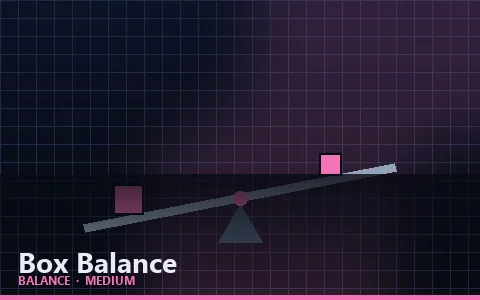
The practical consequence is that a light object placed far from a pivot tips a plank exactly as effectively as a heavy object placed close in. Box Balance displays the lever arm of the pending crate before you drop it, which turns this from something you have to guess into something you can read.
Why toppling accelerates
Once the centre of mass passes outside the base, the structure rotates about the base edge. Rotating moves the centre of mass further out, which increases the turning force, which speeds up the rotation. It is a runaway process, which is why a falling tower goes from 'leaning' to 'gone' so abruptly.
That is also why a domino needs almost nothing to topple. A narrow base and a relatively high centre of mass mean a rotation of a few degrees is enough — and why chains propagate from a single light nudge.
Friction holds it together
Balance decides whether a structure wants to fall. Friction decides whether it slides instead. A crate resting askew is held by friction at the contact, and there is a critical tilt beyond which friction can no longer hold it.
That angle depends only on the friction coefficient, not on the weight — mass cancels out entirely. And because a sliding crate moves outward, increasing its lever arm, a slide almost always makes the tilt worse before it makes it better.
Structures with no joints
Bridge Builder Physics removes joints completely. Nothing you place is attached to anything else: every plank is a rigid body held up by contact, friction and whatever is beneath it.
That makes the load path the thing to think about. A structure stands when the weight it carries reaches the ground through a continuous chain of contacts. A plank supported at only one end has no complete path, so it rotates about its support and drops, however much friction there is.
Moving loads are harder
A structure that holds a static weight can still fail under a moving one. As a load crosses a span, the lever arm changes continuously, and the midpoint of an unsupported deck is where the bending is greatest.
Building for the empty case is the most common reason a bridge fails, which is why the test phase in Bridge Builder Physics is a genuine test rather than a formality.
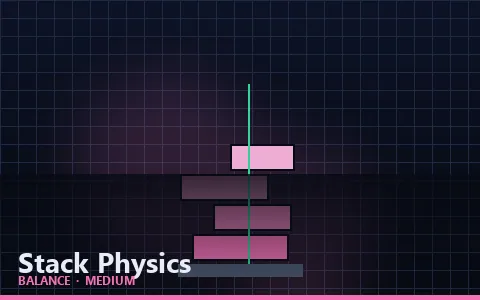
Try it: Stack Physics
Drop crates from a moving crane and build a tower that stays standing.
Play Stack PhysicsHow to play balance games well
- Watch the indicator, not the objects. In games that draw the centre of mass, that line is the only thing that decides the outcome.
- Alternate your overhangs. Consistently hanging over one side walks the centre of mass off the base. Left, right, left, right keeps it centred.
- Heavy low, light high. A dense object near the top pulls the combined centre of mass upward and outward.
- Overlap generously. A third of a plank's length on solid support is a reasonable minimum, whether it is on a bank or on another plank.
- Let things settle. Adding load to a structure that is still moving compounds the error rather than correcting it.