About this game
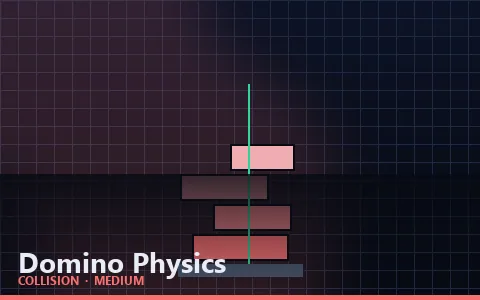
Stack Physics has no grid and no snapping. Each crate lands where it lands, and the tower stands or falls on whether the combined centre of mass stays over the foundation. A dashed line on screen shows you exactly where that centre sits, which turns the game from guesswork into a readable problem.
The crane keeps the crate's sideways velocity when you release it, so a crate dropped at the moment the crane passes your target will land past it. Learning that lead is the difference between a five-storey tower and a twenty-storey one.
How to play
- The crane sweeps back and forth above the tower. Press Space to release the crate.
- The crate keeps the crane's horizontal speed, so release slightly before the crane reaches your target.
- Wait for the crate to settle. The crane speeds up as the tower grows.
- Keep the dashed centre-of-mass line over the foundation. If it drifts too far, the tower goes over.
- The run ends if a crate falls off or the tower topples.
Physics mechanics
Here is what the simulation is actually doing while you play.
Centre of mass
The tower's combined centre of mass is the mass-weighted average position of every crate. While that point sits over the foundation the stack is stable; once it passes the edge, the whole structure rotates about that edge.
Friction between crates
Crates grip each other with a friction coefficient high enough that a slightly askew landing usually holds. That is why an overhang can survive — up to the point where the torque beats the grip.
Impact transmission
A crate landing hard transmits force down through every crate below it. Dropping from height is what dislodges a stack that looked stable a moment earlier.
Objective
Build the tallest stack you can. Every settled crate is another storey.
Scoring
- Each settled crate scores 100 points plus an accuracy bonus of up to 120 for landing close to the crate below.
- A tidy landing (within 18 pixels of centre) extends a streak worth 40 points per crate.
- There is no height bonus beyond the per-crate score — height is simply the product of surviving.
Scores, favourites and play history are stored in your own browser using localStorage. There is no account, no leaderboard and no server: clearing your browser data clears them, and they do not follow you to another device.
Tips
- Lead the crane. The crate inherits the crane's sideways speed. At the crane's fastest, release roughly half a crate-width early.
- Watch the dashed line, not the crates. The centre-of-mass line is the only thing that decides whether the tower stands. If it is drifting, correct on the next drop, not two drops later.
- Alternate your overhangs. If one crate hangs left, make the next hang right. Consistently overhanging one side walks the centre of mass off the base.
- Wide crates recover a lean. The 92-pixel purple crate has the broadest footprint. Save it mentally for when the stack is drifting.
- Drop from the top of the sweep. The crane is momentarily slowest at each end of its sweep. A release there carries the least sideways speed.
Difficulty
Medium. Getting to eight or nine storeys is achievable on a first attempt. Past fifteen, the crane is moving fast enough that lead time dominates, and a single 30-pixel error usually cannot be recovered.
Features
- Crane that sweeps faster as the tower grows
- Live centre-of-mass marker and foundation guide lines
- Four crate shapes with different footprints
- Tidy-placement streak bonus
- Camera that rises with the tower
How accurate is this?
Physics Arcade games use simplified, tuned physics built for playability. They are not scientific simulations: forces, masses and timings are chosen because they feel good at 60 frames per second, not because they match measured values. Where a game departs from real-world behaviour in a way that matters, the game page says so.
Stack Physics – FAQ
Why does my crate land past where I released it?
It keeps the crane's horizontal velocity. The faster the crane is moving, the further past your release point the crate travels.
What is the dashed vertical line?
It marks the tower's combined centre of mass. While it stays between the red foundation guides the stack is stable.
Can a leaning tower recover?
Yes, if you place the next crates on the opposite side. The centre of mass is an average, so new weight on the light side pulls it back.
Does crate shape matter or only position?
Both. A tall narrow crate has a small footprint and tips easily; a wide flat one is a good stabiliser but makes the next layer harder to centre.