Every balance game reduces to one question: is the centre of mass over the base? If it is, the structure stands. If it is not, it rotates, and no amount of friction or careful placement will save it.
That sounds simple, and the simplicity is exactly why balance games are so readable. Unlike most physics, the failure is visible several seconds before it happens. This guide covers what the centre of mass is, how torque decides the outcome, why lever arm matters as much as weight, and how to build things that stay up.
What the centre of mass is
The centre of mass is the average position of all the mass in an object or a group of objects, weighted by how much mass is at each point. It is the single point at which the object behaves, for many purposes, as though all its mass were concentrated.
For a uniform object it is the geometric centre. For a group, it is pulled towards the heavier members — which is why a stack with one very dense crate near the top is far less stable than one with the same crate at the bottom.
It does not have to be inside the object
The centre of mass of a ring is at its centre, where there is no material at all. The centre of mass of a high jumper arching over a bar can pass underneath the bar while every part of them passes over it. It is a calculated point, not a physical one.
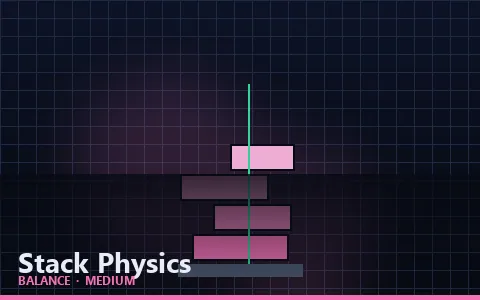
Stack Physics draws the combined centre of mass of the tower as a dashed line dropped to the foundation. That line is the game: while it stays between the guides, the tower stands.
Try it: Stack Physics
Drop crates from a moving crane and build a tower that stays standing.
Play Stack PhysicsThe rule that decides everything
An object stands while a vertical line from its centre of mass falls inside its base of support. It topples when that line falls outside.
The base of support is the area enclosed by all the contact points with the ground. For a box it is the footprint. For a person standing it is roughly the area around and between the feet — which is why a wider stance is more stable, and why standing on one foot is difficult.
Why toppling accelerates
Once the line passes outside the base, the object rotates about the edge. As it rotates, the centre of mass moves further out, which increases the turning force, which speeds up the rotation. It is a runaway process, which is why a falling tower goes from 'leaning' to 'gone' so quickly.
Why a domino needs almost nothing
A domino standing on end has a very narrow base and a relatively high centre of mass, so a rotation of just a few degrees puts the line outside the base. That is why a light nudge topples one, and why Domino Physics chains propagate from a single tip.
| Shape | Base width | Centre of mass height | Stability |
|---|---|---|---|
| Wide flat plank | Large | Low | Very stable |
| Cube | Medium | Medium | Stable |
| Tall narrow crate | Small | High | Tips easily |
| Domino on end | Very small | High | Topples from a nudge |
| Ball | A point | Centre | Never stable — always rolls |
Torque: turning force
Torque is what actually does the tipping. It is the product of a force and the perpendicular distance from the pivot to the line of that force — the lever arm.
The practical consequence is that distance matters exactly as much as weight. A 1 kg mass placed 2 metres from a pivot produces the same torque as a 2 kg mass placed 1 metre away.
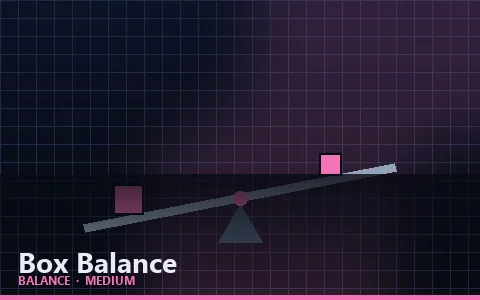
This is the core of Box Balance, which displays the lever arm of the pending crate before you drop it. A light crate far out is genuinely as dangerous as a heavy crate close in, and the readout makes that explicit rather than leaving you to guess.
Balancing torques
A see-saw is level when the torques on both sides are equal. That gives a simple rule: mass₁ × distance₁ = mass₂ × distance₂. A child can balance an adult by sitting far enough out, and that is genuinely all there is to it.
Moment of inertia
How quickly something responds to a torque depends on its moment of inertia — how the mass is spread around the pivot. Mass far from the axis contributes disproportionately, because the contribution goes with the square of the distance.
That is why a wide load on a plank is genuinely slower to swing than a compact load of the same total weight, and why recovering from a bad placement in Box Balance takes longer the more crates are already spread out.
Try it: Box Balance
Balance crates on a plank resting on one pivot. Lever arm matters as much as weight.
Play Box BalanceWhat holds a stack together
Balance decides whether a structure wants to fall. Friction decides whether it can slide instead.
A crate resting askew on another is held by friction at the contact. As the tilt increases, the component of weight trying to slide it down the slope grows while the normal force holding it in place shrinks. At a critical angle friction can no longer hold, and it slips.
That critical angle depends only on the friction coefficient, not on the weight — the mass cancels out. A heavy crate and a light one slip at the same tilt.
Sliding makes balance worse
This is the cruel part. A crate that slides moves outward, which increases its lever arm, which increases the tilt, which makes sliding more likely. In Box Balance a slide almost always makes the situation worse before it makes it better.
Structures with no joints
Bridge Builder Physics removes joints entirely. Every connection in a structure is a friction contact, so a plank needs both enough overlap that its centre of mass stays supported, and a shallow enough angle that friction holds it.
Load paths
A structure stands when the weight it carries reaches the ground through a continuous chain of contacts. A plank supported at only one end has no complete path — it will rotate about its support and drop, no matter how much friction there is.
Why moving loads are harder
A structure that holds a static weight can still fail under a moving one, and this catches out almost everyone the first time.
As a load moves across a span, the lever arm changes continuously. A bridge that is perfectly stable with a cart on either bank can fail with the cart in the middle, because that is where the bending moment is greatest.
A moving load also arrives with momentum. The impact of a cart rolling onto a plank delivers more force than the cart's weight alone, and a structure built to the exact limit of its static capacity has no margin for that.
This is why the test phase in Bridge Builder Physics is a genuine test rather than a formality, and why building for the empty case is the most common reason a span fails.
How to build things that stay up
- Watch the centre of mass, not the objects. In games that draw it, that line is the only thing that matters. If it is drifting, correct on the very next placement.
- Alternate your overhangs. Consistently hanging over one side walks the centre of mass off the base. Left, right, left, right keeps it centred.
- Heavy low, light high. A dense object near the top pulls the combined centre of mass upward and outward; the same object at the bottom anchors the structure.
- Widen the base when you can. A wide flat piece early gives every subsequent piece more margin.
- Overlap generously. Whether it is a plank on a bank or a crate on a crate, a third of the length on solid support is a reasonable minimum.
- Let things settle. Placing a new piece onto a structure that is still moving compounds the error rather than correcting it.
- Judging stability by how it looks. A tower that looks precarious may be perfectly balanced, and one that looks fine may have its centre of mass a pixel from the edge. Use the indicator.
- Assuming heavy means stable. Weight does not help if it is in the wrong place. A heavy crate placed far out is the fastest way to lose a balance game.
- Trying to correct with one large placement. The centre of mass is an average. Several small corrections move it more reliably than one dramatic one.
- Building for the empty case. In any game with a moving load, test the middle of the span mentally before you commit.
The same rule outside of games
Centre of mass is one of the few pieces of physics you can watch working all day, and noticing it makes the games considerably more readable.
Why you cannot stand up from a chair without leaning forward
Sitting, your centre of mass is behind your feet. Standing requires it to be over them. You have to lean forward first — and if someone holds your shoulders back, you genuinely cannot stand, no matter how strong you are. It is a geometry problem, not a strength one.
Why a wider stance is more stable
Widening your feet widens the base of support, so your centre of mass can travel further before it leaves it. The same reasoning makes a tripod stable and a broom balanced on one finger difficult.
Why tall vehicles roll over
A high centre of mass needs less sideways acceleration to move the effective line outside the wheelbase. Lowering the centre of mass, or widening the track, both help — and both are exactly the advice that works in Stack Physics.
Why a high jumper can pass under the bar
Arching the body puts the centre of mass outside it. A jumper curving over a bar can have every part of their body pass above the bar while their centre of mass passes below it — which means they cleared a height their muscles could not have lifted their whole body to.
The transferable habit
In any balance game, stop looking at the objects and start looking for the average. Where is the middle of the weight, and is it over the support? Every balance game on this site becomes easier the moment that question replaces 'does this look stable'.
Try it: Box Balance
Balance crates on a plank resting on one pivot. Lever arm matters as much as weight.
Play Box BalanceKey takeaways
- The centre of mass is the mass-weighted average position of everything in a structure.
- An object stands while a vertical line from its centre of mass falls inside its base of support.
- Toppling accelerates once it starts, because rotating moves the centre of mass further out.
- Torque is force times lever arm, so distance from the pivot matters as much as weight.
- Friction decides whether a leaning object slides, and sliding usually makes balance worse.
- Moving loads change the lever arm continuously, so a static test is not enough.
Frequently asked questions
What is the centre of mass?
The mass-weighted average position of all the matter in an object or group. It is the point at which the object behaves as though all its mass were concentrated, and it need not lie inside the object at all.
Why do towers fall over?
Because the combined centre of mass drifted outside the base of support. Once that happens the structure rotates about the base edge, and rotating moves the centre of mass further out, so it accelerates.
What is torque in simple terms?
Turning force. It equals the force applied times the perpendicular distance from the pivot, which is why a light object placed far out can tip a plank as effectively as a heavy one placed close in.
Does a heavier object slide at a shallower angle?
No. The critical angle at which friction gives way depends only on the friction coefficient — the mass cancels out entirely. A heavy and a light crate slip at exactly the same tilt.
Why is my bridge failing halfway across?
Because a moving load changes the lever arm continuously, and the middle of an unsupported span is where the bending moment is greatest. A structure that holds while empty can still fail under a load in motion.
How do I make a stack more stable?
Keep heavy pieces low, alternate which side you overhang, widen the base early, and let each piece settle before adding the next. Watching the centre-of-mass indicator beats judging by eye.
References
Physical concepts in this guide were checked against the following educational sources. None of them are affiliated with Physics Arcade.