About this game
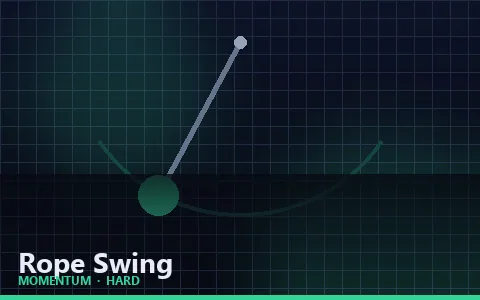
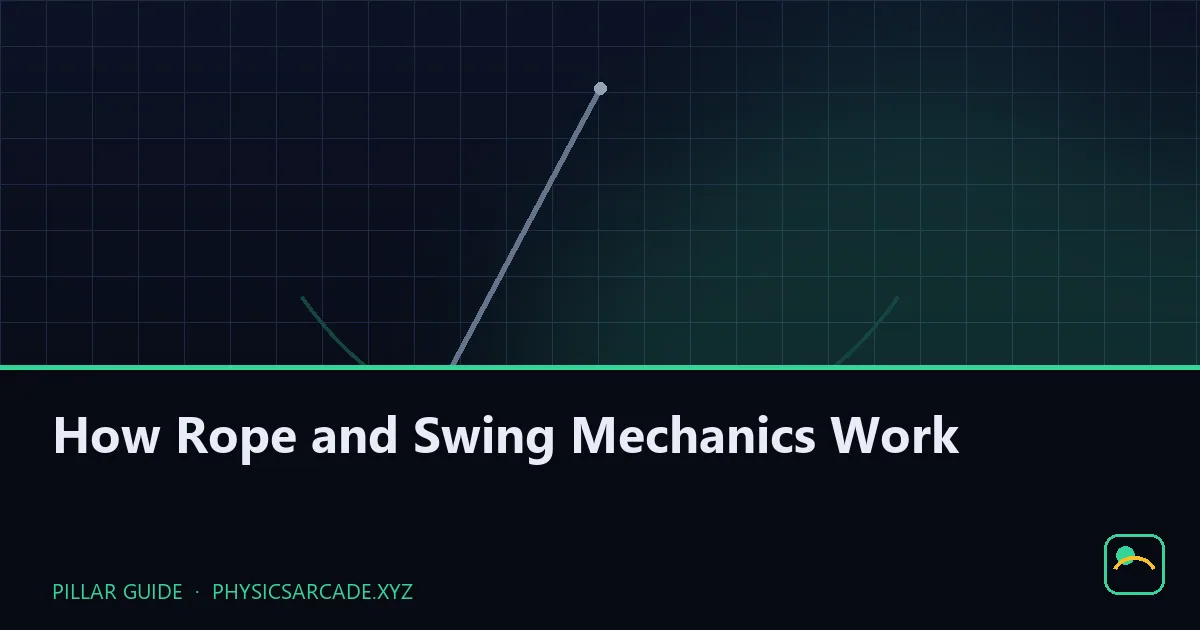
Pendulum Dash is a game about one decision made repeatedly: when to let go. Each bob swings on a rod of its own length, and a longer rod takes longer to complete a swing regardless of how heavy the bob is. The safe release window therefore moves relative to every other pendulum in the row.
Release at the bottom of a swing and you inherit the bob's maximum speed, thrown almost horizontally. Release a quarter-swing later and you get less speed but more height. Every gap in the game has a right answer somewhere between those two.
How to play
- Start on the left ledge. Press Space when you are near a bob to grab it.
- While held, you ride the bob exactly — its velocity becomes yours.
- Press Space again to release. You keep whatever speed and direction the bob had at that moment.
- Chain grabs across the gap and land on the green ledge on the right.
- Falling into the gap ends the run. Clear six crossings to finish.
Physics mechanics
Here is what the simulation is actually doing while you play.
The pendulum equation
Each bob integrates θ'' = −(g / L)·sin θ — the full equation rather than the small-angle approximation. That is why a wide swing genuinely slows near the top instead of moving at a constant angular rate.
Period depends on length
A pendulum's period is set by its rod length and gravity, not by the mass of the bob. Longer rods swing more slowly, which is why the bobs in a row drift in and out of phase with each other.
Tangential release velocity
The bob's velocity is ω × L, directed along the tangent of its arc. When you release, that exact vector becomes yours — which is why the release angle controls whether you get distance or height.
Momentum into the swing
Grabbing while moving adds the component of your velocity along the bob's travel direction to its angular velocity. Arriving fast makes the next swing faster.
Objective
Cross each gap and land on the far ledge. Six crossings complete the run.
Scoring
- Each new bob grabbed is worth 60 points.
- Completing a crossing awards 600 points plus a time bonus decaying at 60 points per second.
- Every bob you did not need to use is worth a further 80 points.
Scores, favourites and play history are stored in your own browser using localStorage. There is no account, no leaderboard and no server: clearing your browser data clears them, and they do not follow you to another device.
Tips
- Release at the low point for distance. The bob is moving fastest at the bottom of its arc, and that velocity is almost horizontal — exactly what a long gap needs.
- Release later for height. If the next bob is high, hold on past the low point. You trade speed for a steeper launch angle.
- Arrive fast. Your momentum feeds into the swing when you grab. A fast arrival means a faster swing and an easier next release.
- Yellow means in range. A bob turns yellow with a dashed ring when it is within grab range. If nothing is yellow, pressing Space does nothing.
- Watch the velocity arrow. The yellow line from your capsule shows your current velocity. If it is pointing down rather than forward, you released too late.
Difficulty
Hard. The timing window is genuinely tight and the game gives you no assist. Crossing one is a fair tutorial; crossings four to six require chaining grabs without losing speed, which takes practice rather than reaction time.
Features
- Pendulums solved with the full equation, not the small-angle shortcut
- Six crossings with increasing spacing
- Momentum transfer from you into the swing when you grab
- Release velocity inherited from the bob's tangential speed
- Efficiency bonus for using fewer bobs
How accurate is this?
Physics Arcade games use simplified, tuned physics built for playability. They are not scientific simulations: forces, masses and timings are chosen because they feel good at 60 frames per second, not because they match measured values. Where a game departs from real-world behaviour in a way that matters, the game page says so.
Pendulum Dash – FAQ
Does a heavier bob swing differently?
No. A pendulum's period depends on its length and on gravity, not on the mass of the bob — one of the results this game is built to demonstrate.
Why did my release send me straight down?
You released at the top of a swing, where the bob is momentarily almost stationary. Aim for the bottom of the arc.
Can I grab the same bob twice?
Yes, but it only scores the first time. Re-grabbing is a valid recovery when a release goes wrong.
Do the bobs slow down over time?
Barely. They carry a very small damping term so the timing stays stable through a crossing.