Momentum is mass times velocity, and it is the quantity that makes physics games feel unlike anything else. A character with momentum cannot stop instantly, cannot turn instantly, and arrives at every situation carrying the consequences of the last one.
Players who find physics games frustrating are usually fighting momentum. Players who find them satisfying have learned to spend it. This guide covers what momentum is, how it transfers, why it is conserved, and what all of that means at the controls.
What momentum actually is
Momentum is written p = m·v — mass times velocity. It is a vector, so it has a direction as well as a size, and that direction matters as much as the number.
The practical meaning is 'how hard this is to stop'. A heavy slow object and a light fast one can carry the same momentum, but they behave very differently on impact, because the light one also carries far more kinetic energy.
| Object | Mass | Speed | Momentum | Kinetic energy |
|---|---|---|---|---|
| Trigger sphere | High | Moderate | High | Moderate |
| Relay ball | Low | Fast | Similar | Higher |
| Domino | Very low | Slow | Low | Very low |
Momentum versus kinetic energy
Momentum is m·v; kinetic energy is ½m·v². Doubling the speed doubles the momentum but quadruples the energy. That is why a fast light object does disproportionate damage while a slow heavy one is harder to deflect.

Try it: Zero Gravity Arena
No gravity, no friction, no brakes. Every burn you make is permanent.
Play Zero Gravity ArenaInertia: why you cannot stop
Newton's first law says an object in motion stays in motion unless a force acts on it. In most games something always acts — friction, drag, an artificial deceleration — and the player never notices.
Zero Gravity Arena removes all of them. No gravity, no drag, no friction. The pod's velocity changes only when you thrust, and it never changes back on its own. Every burn has to be undone by another burn.
This is genuinely disorienting for players used to games where releasing a key slows you down, and it is the clearest demonstration of inertia available in an arcade format.
Why 'release to stop' is unrealistic
In most games, letting go of the movement key brings the character to a halt within a few frames. That is not friction — friction would take a distance proportional to the square of your speed. It is an artificial damping chosen because it feels responsive.
Physics games often keep some of that damping for playability, but much less. In Rolling Reactor the sphere coasts for a long way, because a rolling body loses very little energy.
Conservation of momentum
In any collision, the total momentum of the system before equals the total momentum after. This is not an approximation — it is one of the most reliable statements in physics, and game engines implement it directly.
What it means in practice is that momentum is redistributed rather than created or destroyed. If a heavy object hits a light one, the light one leaves fast and the heavy one slows slightly. The sum is unchanged.
Elastic and inelastic collisions
Momentum is always conserved. Kinetic energy is not.
- In a perfectly elastic collision, kinetic energy is also conserved. Nothing is lost to heat or deformation. This is a useful idealisation — the walls in Ricochet Lab are perfectly elastic so the puzzle stays solvable.
- In an inelastic collision, some kinetic energy is lost. This is what real collisions do, and it is why a chain reaction eventually runs out of energy.
The coefficient of restitution measures where a collision sits between the two. See How Bounce and Restitution Work for the detail.
Momentum transfer in gameplay
Transferring momentum from one object to another is the core mechanic of an entire family of games.
Chain reactions
Chain Reaction Lab passes momentum along a chain of objects. The trigger sphere is deliberately heavy, because momentum is mass times velocity and a dense trigger carries far more of it into the first collision.
Every link loses some to friction and to inelastic contact, so a chain that is one stage too long visibly slows and stops. Watching where a chain dies tells you exactly where the energy budget ran out.
Dominoes
Domino Physics is momentum transfer at its most legible. Each piece converts stored height into rotational speed, then hands that on. Spacing controls how much energy each link receives: too far and the chain misses, too close and pieces cannot gather speed.
Pushing heavy things with light things
The momentum stage of Physics Challenge makes this explicit. The crate is roughly six times the mass of a puck, so one puck barely moves it — but pucks add their momentum together, and five delivered to the same point move it substantially.

Try it: Chain Reaction Lab
Drop one trigger sphere and let momentum carry the cascade to every sensor.
Play Chain Reaction LabAngular momentum: momentum that spins
Rotating objects have their own version. Angular momentum depends on how mass is distributed around the axis as well as how fast the object is turning.
The best-known consequence is the skater effect: pull your arms in and you spin faster, because angular momentum is conserved and you have reduced your rotational inertia.
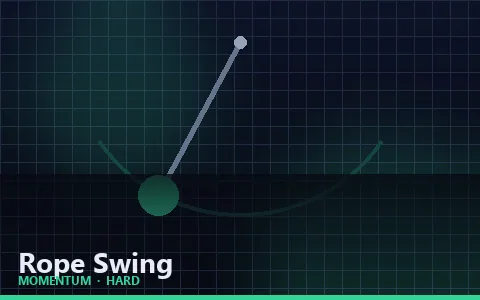
Rope Swing uses this directly. Reeling the rope in while swinging reduces the radius, and the swing speeds up. Over a long run it is the difference between five hundred metres and two thousand.
Rolling is momentum in two forms at once
A rolling sphere carries linear momentum (moving forward) and angular momentum (spinning). They are coupled by the contact with the ground: v = ω·r. That coupling is why a rolling body loses so much less energy than a sliding one, and it is the whole basis of Rolling Reactor.
Why momentum is what makes a game 'feel heavy'
Game designers talk about weight and feel as though they were aesthetic properties. They are not — they are almost entirely consequences of how much momentum a character carries and how quickly they are allowed to change it.
Three numbers decide it, and adjusting them moves a character along a spectrum from twitchy to ponderous.
| Parameter | Low value | High value |
|---|---|---|
| Acceleration | Sluggish, slow to start | Twitchy, responsive |
| Damping / friction | Slippery, long stopping distance | Stops instantly, feels weightless |
| Mass | Easily knocked around | Shrugs off impacts |
The combination that most players read as 'good weight' is moderate acceleration with low damping: you take a moment to get going and a moment to stop, but you are always in control. High acceleration with high damping produces a character that feels responsive but weightless — it starts and stops instantly, and nothing about it suggests mass.
Why physics games rarely use high damping
Because damping is the thing that hides momentum. A game where releasing the key stops you immediately is a game where momentum never becomes a problem to solve, and the whole genre is built on momentum being a problem to solve.
The games on this site sit deliberately low on damping. Rolling Reactor uses rolling resistance rather than braking, Friction Runner makes the damping itself the subject, and Zero Gravity Arena removes it entirely.
Impulse control versus continuous control
How a game hands you momentum shapes how it plays more than almost any other decision.
Continuous control
You hold a key and a force is applied for as long as you hold it. Momentum builds gradually, and you can modulate it at any moment. This is the model in Rolling Reactor, Friction Runner and most running games.
Continuous control is forgiving, because every frame is a chance to correct. It also makes it hard to be precise, because you are integrating your own input over time and it is genuinely difficult to know how much you have applied.
Impulse control
You commit once, and a fixed amount of momentum is delivered instantly. Pendulum Dash, Planet Hopper and Spring Jump all work this way.
Impulse control is unforgiving in the moment and much easier to reason about between moments. You can think about a jump for as long as you like, and the jump you get is exactly the jump you specified.
Which one a game chooses tells you how to play it
If the game gives you continuous control, small early inputs beat large late ones. If it gives you impulse control, the time to think is before you commit — and hesitating mid-flight achieves nothing, because you have already spent your input.
How to use momentum instead of fighting it
This is the single biggest skill difference between a new physics player and an experienced one.
- Plan the stop before the start. In any low-friction game, decide where you will decelerate before you accelerate. In Zero Gravity Arena this is the whole game.
- Chain your objectives. Momentum is free once you have it. A route that passes through three targets on one heading beats three separate trips every time.
- Enter low-grip sections at the right speed. On ice you can neither accelerate nor brake, so the speed you carry in is the speed you carry out. This is the core insight of Friction Runner.
- Convert between forms. Height becomes speed and speed becomes height. A downhill is not a fast section, it is a deposit into the next climb.
- Reduce the radius to go faster. In any swinging or rotating system, pulling in speeds you up. Reel in on every swing.
- Braking early 'to be safe'. In momentum games, speed you shed is speed you have to earn again. Most cautious runs fail on the clock rather than on a hazard.
- Steering with continuous small corrections. Each correction adds momentum in a new direction that then has to be cancelled. Make one decisive input instead of ten small ones.
- Using maximum force to move heavy objects. Momentum adds. Several moderate impacts at the same point are usually more effective and far more controllable than one huge one.
- Forgetting that you are still moving. In a frictionless environment, every moment of indecision is a moment of continued travel in the last direction you chose.
Key takeaways
- Momentum is mass times velocity — a measure of how hard something is to stop.
- Momentum is always conserved in a collision; kinetic energy is not.
- Inertia means objects keep moving until a force stops them, and many games hide this with artificial damping.
- Momentum transfer is the core mechanic of chain reactions, dominoes and impact puzzles.
- Angular momentum explains why reeling in a rope speeds up a swing.
- Skilled play is about spending momentum well, not about generating more of it.
Frequently asked questions
What is momentum in a game?
Mass times velocity. It determines how hard an object is to stop or turn, and it is what makes a physics character feel weighty rather than instantly responsive.
Why can I not stop instantly in physics games?
Because stopping requires a force to remove your momentum, and that force acts over time. Games that let you stop instantly are applying an artificial damping that real motion does not have.
What is the difference between momentum and kinetic energy?
Momentum is m·v and kinetic energy is ½m·v². Doubling speed doubles momentum but quadruples energy, which is why fast light objects hit disproportionately hard.
Is momentum always conserved?
In a closed system, yes — total momentum before a collision equals total momentum after. Kinetic energy is only conserved in perfectly elastic collisions, which is why chains eventually run out of energy.
Why does reeling in a rope make me swing faster?
Angular momentum is conserved. Reducing the radius reduces rotational inertia, so the angular speed increases to compensate — the same reason a spinning skater speeds up by pulling their arms in.
How do I get better at momentum-based games?
Plan where you will slow down before you speed up, chain objectives onto a single heading, and stop making continuous small corrections. Most improvement comes from making fewer, earlier, more decisive inputs.
References
Physical concepts in this guide were checked against the following educational sources. None of them are affiliated with Physics Arcade.