About this game
Rolling Reactor does not push the sphere sideways. The arrow keys apply torque, spinning it, and friction at the contact patch is what turns that spin into forward motion. If the sphere is in the air, the keys do almost nothing — which is exactly how a real wheel behaves.
The consequence is that the course has to be read in terms of energy. A downhill is not just a fast section; it is where you bank the speed that gets you up the next rise. A rolling body loses far less energy than a sliding one, so the sphere holds what it earns — as long as you stay on the ground.
How to play
- Hold Right to spin the sphere forward. Grip does the rest.
- Build speed on the downhills so you can carry it up the next climb.
- Collect green energy cells, which sit at the crests of the harder climbs.
- Ride the gold boost strips for free speed on long rises.
- Reach the green reactor gate before the 52-second clock expires.
Physics mechanics
Here is what the simulation is actually doing while you play.
Rolling versus sliding
A rolling body loses far less energy than a sliding one, because the contact point is momentarily stationary relative to the ground. That is why the sphere holds its speed across a long flat section.
Torque and grip
Torque spins the sphere; friction converts that spin into forward force. On a high-grip surface the sphere accelerates hard. In the air, with no contact, torque produces spin and nothing else.
Energy exchange on slopes
Going downhill converts height into speed and going uphill converts speed back into height. Nothing is created — the fastest run is the one that wastes the least on the way.
Rolling resistance
A small speed-proportional loss models the deformation of a real rolling contact. It is much gentler than sliding friction, which is why coasting works.
Objective
Reach the reactor gate at the end of each course before the timer runs out.
Scoring
- Each energy cell is worth 90 points.
- Clearing a course awards 500 points plus 30 points per second remaining and 40 per cell.
- Falling into a pit ends the run regardless of score.
Scores, favourites and play history are stored in your own browser using localStorage. There is no account, no leaderboard and no server: clearing your browser data clears them, and they do not follow you to another device.
Tips
- Hold the key through the whole climb. Grip is what climbs hills. Tapping produces bursts of spin that slip rather than accelerate.
- Do not brake on descents. Every metre of downhill is speed you will need. Braking early is the most common reason a run runs out of time.
- Watch the ground indicator. The 'Rolling' / 'Airborne' label tells you whether your inputs are doing anything. Airborne means you are committed.
- Boost strips need speed. The gold arrows add to your existing speed. Hitting one already slow is far less useful than hitting it fast.
- Cells are on the hard line. Energy cells sit at crests. Taking them usually means committing to the faster, riskier route — which is also the route that beats the clock.
Difficulty
Medium. Course one is a gentle series of hills with no pits. Pits appear from course two and get wider; by course five the clock is tight enough that a cautious run will not finish.
Features
- Torque-driven movement — grip converts spin into travel
- Six hand-seeded courses of hills, drops and pits
- Boost strips on the long climbs
- Energy cells placed at crests to reward carrying speed
- Rolling resistance model separate from sliding friction
How accurate is this?
Physics Arcade games use simplified, tuned physics built for playability. They are not scientific simulations: forces, masses and timings are chosen because they feel good at 60 frames per second, not because they match measured values. Where a game departs from real-world behaviour in a way that matters, the game page says so.
Rolling Reactor – FAQ
Why does the sphere not respond in the air?
Torque needs grip to become motion. Off the ground there is nothing to push against, so spinning does very little. A small air-steering assist is included so jumps are recoverable.
How do I stop?
Hold the opposite direction. Braking is the same mechanism as accelerating, so it takes a similar distance.
Why do the spokes on the sphere matter?
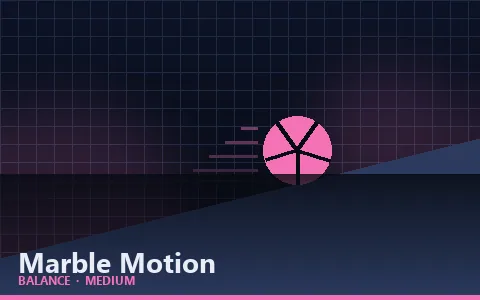
They are a visual cue for the actual rotation. If they are spinning faster than the sphere is travelling, you are slipping rather than rolling.
Are the courses the same every time?
Yes. Each course number uses a fixed seed, so learning the terrain of course four is worthwhile.