

Momentum is the resource
Momentum is mass times velocity, and in this category it is the thing you are managing. These games are not about going fast; they are about not wasting the speed you have already earned.
Players who find physics games frustrating are usually fighting momentum. Players who find them satisfying have learned to spend it. That shift is the single biggest skill difference in the whole genre, and it is most visible here.
Inertia: why you cannot stop
Newton's first law says an object in motion stays in motion unless a force acts on it. In most games something always acts — friction, drag, an artificial deceleration — and the player never notices.
These games remove most of it. The sphere in Rolling Reactor coasts for enormous distances because a rolling body loses very little energy. The float in Fluid Drift is carried by the current whether it likes it or not.
Rolling versus sliding
A rolling object loses far less energy than a sliding one, because the contact point is momentarily stationary relative to the ground, so kinetic friction never engages. What remains is rolling resistance, typically a tenth or less of sliding friction. That is why a wheel was such a good idea.
Friction limits both directions
Friction is what lets you accelerate as well as what slows you down. Without grip you cannot push off the ground at all, which is why ice removes your control in both directions at once.
Friction Runner makes this the entire subject, printing each surface's coefficient directly on the track. On ice you can neither speed up nor slow down, so the only workable strategy is to arrive at the speed you intend to leave at.
Stopping distance grows with the square of speed and inversely with grip. Arriving at an ice section at double speed on a fifth of the grip means a stopping distance twenty times longer — in practice, longer than the level.
Converting between forms
Height becomes speed and speed becomes height. A downhill is not a fast section; it is a deposit into the next climb. The fastest run in Rolling Reactor is the one that wastes the least on the way.
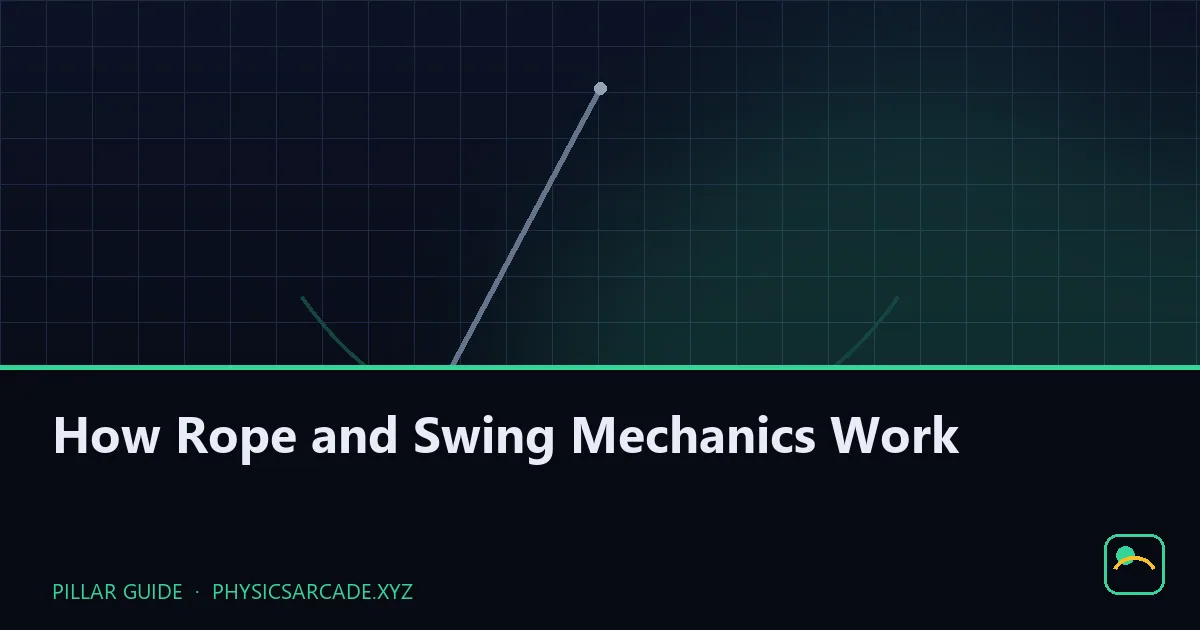
Rope Swing converts in a different way. While the rope is taut it removes the component of velocity pointing along it, which is exactly what turns a fall into a swing. Reeling in shortens the radius and speeds up the arc — the same reason a skater spins faster with their arms pulled in.
Indirect control
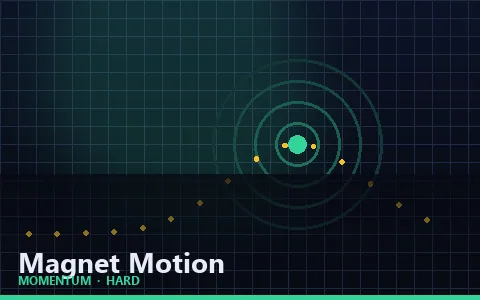
Magnet Motion is the extreme case: you never touch the orb at all. You move a magnet and decide whether it pulls or pushes, and everything else is the force law working itself out.
Because the force is inverse-square, a magnet parked on top of the orb is uncontrollable — the pull there is enormous. Good play means working from a distance, in short pulses, and spending as much effort cancelling the orb's momentum as creating it.

Try it: Rolling Reactor
Roll a heavy sphere over hills and gaps, using downhills to earn the next climb.
Play Rolling ReactorHow to play momentum games well
- Plan the stop before the start. Decide where you will decelerate before you accelerate.
- Chain your objectives. A route that passes through three targets on one heading beats three separate trips.
- Enter low-grip sections at the right speed. On ice, the speed you carry in is the speed you carry out.
- Reduce the radius to go faster. In any swinging system, reeling in speeds you up.
- Stop correcting. Each small correction adds velocity that then has to be cancelled. One decisive input beats ten.