

Collision as the subject, not the moment
In most games a collision is an event that interrupts something else. In collision games the impact is the subject: what transfers, how much is lost, and whether the next thing in line receives enough to keep going.
That makes this the category where the underlying physics is most directly visible. Watching where a chain reaction dies tells you exactly where the energy budget ran out.
Momentum transfer
Momentum is mass times velocity, and it is conserved in every collision. It is redistributed rather than created or destroyed: if a heavy object hits a light one, the light one leaves fast and the heavy one slows slightly, and the total is unchanged.
That is why the trigger sphere in Chain Reaction Lab is deliberately heavy. A dense trigger carries far more momentum into the first collision than a light one at the same speed, and the cascade needs all of it.
Momentum and kinetic energy are different
Momentum is m·v; kinetic energy is ½m·v². Doubling the speed doubles the momentum but quadruples the energy. That is why a fast light object hits disproportionately hard while a slow heavy one is harder to deflect.
Elastic and inelastic
Momentum is always conserved. Kinetic energy is not. A perfectly elastic collision loses nothing; a perfectly inelastic one loses the maximum possible and the objects move together afterwards. Everything real sits between the two.
That loss is why chains have a finite reach. Every link in a cascade loses some energy to friction and to inelastic contact, so a chain that is one stage too long will visibly slow and stop — and no amount of aiming fixes it.
Toppling is collision plus torque
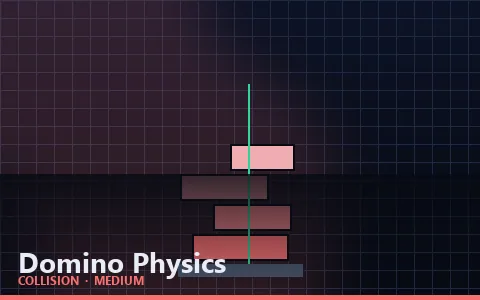
Domino Physics is the most legible game in the category. A domino falls once its centre of mass passes outside its base, and because the base is narrow a very small rotation is enough.
The failure modes are symmetrical and both instructive. Too far apart and a falling piece never reaches the next one. Too close together and a piece cannot rotate far enough to build the speed it needs — the chain moves but runs out within a few pieces.
Many bodies at once
Particle Push is the game that exercises the engine hardest. Every particle collides with every other one, so a packed group transmits your push through the pile rather than each particle responding individually.
Making that run smoothly on a phone requires a broad phase — a cheap first pass that eliminates pairs that cannot possibly touch. Above about forty bodies the engine switches from testing every pair to a uniform spatial hash, which is the difference between the game running and not.
Collisions with nothing to slow you
Zero Gravity Arena strips away gravity, drag and friction entirely. The pod's velocity changes only when you thrust, and the walls are elastic enough to send a careless burn straight back at you.
It is the clearest demonstration of Newton's first law available in an arcade format, and genuinely disorienting for players used to games where releasing a key slows you down.

Try it: Chain Reaction Lab
Drop one trigger sphere and let momentum carry the cascade to every sensor.
Play Chain Reaction LabHow to play collision games well
- Aim the trigger at the chain, not at the goal. The trigger's job is to start the sequence with maximum momentum, not to reach the target itself.
- Expect energy loss. Every contact costs something. If a cascade stops at the same point every time, the problem is upstream.
- Drop from height. A longer fall means more speed at impact, which means more momentum to pass along.
- Watch where the chain dies. That is the break point, and it tells you exactly which link needs more energy or tighter spacing.
- Use the crowd. In many-body games, compacting a group and pushing once beats chasing individuals.