
Why projectile games are the most learnable
Projectile motion has a closed-form answer. Once an object leaves your control, its entire path is determined by two numbers — the speed and the angle you gave it — plus gravity. Nothing else happens.
That makes this the one category where you can genuinely learn to eyeball the result. An arc is predictable in a way that a chain reaction or a settling stack is not, and practice converts directly into accuracy.
Two independent motions
The key insight is that horizontal and vertical motion are completely independent. Gravity acts only downward, so horizontal velocity never changes while vertical velocity changes constantly.
Combining a straight line in one axis with an accelerating motion in the other gives a parabola. Every arc in every projectile game is that same shape, stretched differently.
The classic demonstration
Drop one ball and simultaneously fire another horizontally from the same height. They hit the ground at the same moment. The horizontal velocity of the second ball has no effect at all on how long it takes to fall.
Angle and range
For a fixed launch speed on level ground with no air resistance, maximum range comes at 45 degrees. A shallow angle gives high horizontal speed and little hang time; a steep one gives lots of hang time and little horizontal speed. Forty-five splits the difference.
In practice 45 is almost always wrong. The pillars in Cannon Curve exist specifically to force a steeper shot, and wind shifts the optimum sideways in a way no single angle captures.
A useful property: complementary angles give the same range. Thirty degrees and sixty degrees land in the same place at the same speed. The high shot takes longer and arrives more steeply, which is often the more useful of the two.
Bounce and restitution
Three of these five games are really about what happens after the landing. Restitution is the fraction of approach speed a surface returns, and it decides whether a shot dies on contact or keeps working.
Bounce Lab pays more for targets hit after more bounces, which aligns the scoring with the physics — the interesting shot and the high-scoring shot are the same shot. Ricochet Lab goes further and requires a minimum number of bounces before a hit counts at all.
Perfectly elastic walls
Ricochet Lab uses a restitution of exactly 1.0, which is physically impossible — every real collision loses energy to heat, sound and deformation. It is there deliberately: with no energy loss and no gravity, every path is made of straight lines and the puzzle is solvable by reasoning rather than by trial.
That is a good example of a departure from real physics that makes a better game. The game page says so explicitly rather than pretending the behaviour is realistic.
Springs are projectile launchers
Spring Jump belongs here because a spring launch is a projectile launch. What makes it distinct is where the energy comes from: a spring stores energy in proportion to the square of its compression, so a full charge is worth roughly four half charges rather than two.
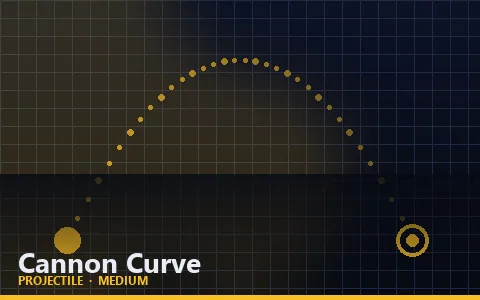
Try it: Cannon Curve
Set an angle and a power, then drop an energy orb onto the targets.
Play Cannon CurveHow to aim well
- Set power first, then angle. Changing both at once makes your previous shot uninformative.
- Spend a ranging shot. With several projectiles in hand, a deliberate first miss teaches you more than a hopeful attempt.
- Prefer the high solution around obstacles. Complementary angles give the same range and the steeper one clears more.
- Aim upwind, not at the target. Wind drift grows with the square of flight time, so compensate at launch.
- Use the bounce. A short shot that rolls into a target scores the same as a direct hit and is often easier to set up.