Gravity is the force players understand best and think about least. Everyone knows things fall. Rather fewer notice that falling objects keep speeding up, that gravity is a direction as much as a strength, or that the same field can hold something in orbit and slam something else into the ground.
This guide covers what gravity does in a game, the four ways games change it to make new mechanics, and what that means for how you play.
Gravity is an acceleration, not a speed
The single most important thing about gravity is that it does not give objects a speed. It gives them a change in speed, every second, for as long as they are falling.
On Earth that change is about 9.8 metres per second, every second. After one second of falling you are moving at 9.8 m/s; after two seconds, 19.6 m/s; after three, 29.4 m/s. The speed grows steadily, and the distance covered grows with the square of the time.
| Time falling | Speed | Distance fallen |
|---|---|---|
| 1 second | 9.8 m/s | 4.9 m |
| 2 seconds | 19.6 m/s | 19.6 m |
| 3 seconds | 29.4 m/s | 44.1 m |
| 4 seconds | 39.2 m/s | 78.4 m |
That squared relationship is why a small mistiming near the top of a fall costs very little and the same mistiming lower down is fatal. It is also why the cells in the gravity stage of Physics Challenge draw speed streaks — the streak length shows the acceleration directly.
Mass does not matter
Gravity accelerates everything at the same rate regardless of mass. A feather and a brick fall identically in a vacuum — the feather only loses because of air resistance, which is a separate force. In Newton's Playground you can switch to moon gravity and watch the light purple ball and the dense pink hexagon fall at exactly the same rate.
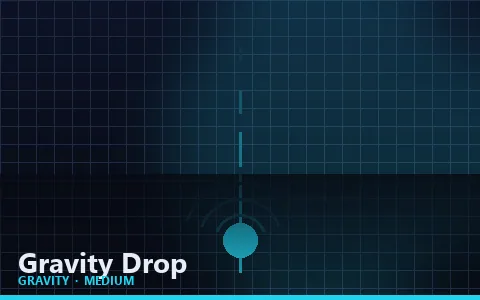
Try it: Gravity Drop
Fall through a shaft of solid platforms while a rising hazard line chases you down.
Play Gravity DropTerminal velocity: why falls stop accelerating
If gravity accelerated things forever, a long fall would be uncontrollable. In reality — and in well-made games — air resistance grows with speed until it balances gravity, and the fall settles at a constant terminal velocity.
That balance point is what makes falling games playable. In Gravity Drop the capsule reaches terminal velocity within about a second, which is why the descent feels fast but steerable rather than accelerating into chaos.
How games implement it
Two approaches are common. Linear damping multiplies velocity by a factor slightly less than one each step — cheap, stable and the right choice for arcade feel. Quadratic drag applies a force proportional to the square of speed, which is closer to real air resistance and gives a more pronounced terminal velocity. Air Balloon Physics uses quadratic drag, which is why the balloon feels so heavy.
A third approach — simply clamping the maximum speed — is common but feels wrong, because the fall accelerates at full rate and then abruptly stops accelerating.
Gravity as a direction
Gravity is a vector: it has a strength and a direction. Games that treat it as a vector rather than as 'down' unlock an entire family of mechanics.
Reversed gravity
Flip the sign and everything falls upward. The interesting part is what survives the flip: your horizontal momentum does, which is why Gravity Switch is about carrying speed through the inversion rather than about the inversion itself.
Rotated gravity
Point gravity sideways and walls become floors. Gravity Maze rotates the field in 90-degree steps and removes steering entirely: you choose which way is down, and the cube slides until something stops it.
Analogue tilt
Marble Motion uses a continuously variable direction. Viewed from above, the in-plane force is g × sin(tilt), so a small tilt gives a small push and the relationship is smooth rather than stepped.
Local gravity zones
A region of the level can carry its own field. The Gravity Zone of Physics Arcade Ultimate uses flip pads that change the global field; other designs use zones that only apply inside a boundary.
Why transitions are eased
Snapping the gravity vector instantly reads as a rendering glitch rather than a physical event. Interpolating over about a tenth of a second makes a flip legible — and briefly weightless, which players find satisfying.
Point gravity and gravity wells
So far gravity has been uniform — the same everywhere. Real gravity is not: it comes from masses, and it gets weaker with distance according to an inverse-square law.
Halve your distance from a planet and the pull quadruples. That single relationship produces all of orbital mechanics, and it is what makes Orbital Dash the hardest game on this site.
Why orbits work
An orbit is a balance. Move too slowly and the pull wins, and you spiral in. Move too fast and you escape. At exactly the right speed for your distance, you fall towards the planet at precisely the rate the planet curves away beneath you, and you go round forever.
The counter-intuitive result
Thrusting forward in an orbit does not make you arrive sooner. It raises the opposite side of your orbit, which makes the orbit bigger and the trip longer. Thrusting backwards lowers the opposite side. This genuinely surprises people the first time, and it is the core skill in Orbital Dash.
Softening
An inverse-square force becomes infinite at zero distance, which would fling objects out of the simulation. Every implementation adds a softening term to the denominator so the force stays finite. It is a standard technique, not a hack — astrophysical simulations do the same thing.
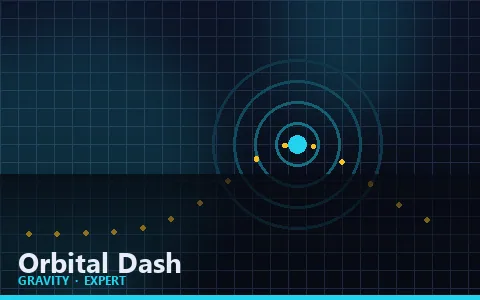
Try it: Orbital Dash
Thread a probe between gravity wells, collecting rings without crashing or escaping.
Play Orbital DashRadial gravity and walking on spheres
If a planet pulls towards its centre, then standing on its surface means 'down' points at the centre — and walking around it rotates your personal down with you.
Planet Hopper is built entirely on this. Walk far enough around a small rock and you are upside down relative to where you started, without anything feeling wrong, because the field rotated with you.
Surface gravity and size
Surface gravity depends on both a body's mass and its radius. Smaller bodies generally pull less, which is why the same jump charge throws you clear across a cluster from a pebble and barely lifts you off the largest planet. The game prints each planet's value on it so the relationship is visible rather than guessed.
This is why lunar footage looks the way it does. The Moon's surface gravity is roughly a sixth of Earth's, so the same push produces a far longer, higher bound.
Buoyancy: gravity working in your favour
Things float for the same reason things fall. Buoyancy is not a separate force pushing upward out of nowhere — it is the consequence of gravity acting on the fluid around an object.
A submerged object displaces some fluid. That fluid has weight, and if it weighs more than the object does, the object rises. If it weighs less, the object sinks. The net upward push equals the weight of the displaced fluid, which is Archimedes' principle.
Air Balloon Physics reduces this to one control. Heating the envelope makes the air inside less dense, so the balloon displaces the same volume while weighing less, and the difference becomes lift. Venting reverses it.
Fluid Drift uses the same idea for a different effect: the float's buoyancy scales with how deep it sits, so it settles at a natural rest depth and returns there when disturbed. Fighting that line costs you speed, which is the whole tension of the game.
Where the arcade model departs
Real buoyancy depends on fluid density, temperature and the exact displaced volume, all of which change continuously. Both games collapse that into a single 'submersion' or 'heat' value. The direction of every effect is faithful; none of the numbers are.
Choosing a gravity value for a game
Game gravity is never 9.8. That number is in metres per second squared, and a game works in pixels, so the first job of any physics game is to decide what a pixel is worth.
The practical method is to work backwards from feel. Pick how long a full-screen fall should take — about one second usually reads as 'normal' — and solve for the acceleration that produces it. For a play area roughly 700 pixels tall, that lands near 1,500 pixels per second squared, which is the value the games on this site use as their baseline.
| Preset | Value (px/s²) | Feels like | Used by |
|---|---|---|---|
| None | 0 | Deep space | Zero Gravity Arena, Ricochet Lab |
| Micro | 120 | Drifting in orbit | Force-field puzzles |
| Moon | 260 | About a sixth of normal | Low-gravity sections |
| Low | 620 | Floaty but grounded | Magnet Motion |
| Normal | 1,500 | Arcade default | Most games |
| Heavy | 2,400 | Weighty, urgent | Gravity Maze |
| Crushing | 3,600 | Punishing | Hard sections |
Having a named set of presets rather than magic numbers scattered through the code matters more than it sounds. It means a designer can say 'this section should feel like the Moon' and get a consistent result, and it means changing the baseline updates everything at once.
How to play gravity games well
Most gravity-game mistakes come from forgetting that the force is continuous and cumulative.
- Act before you need to. Gravity has been acting on you the whole time you were deciding. Corrections made late have to fight accumulated velocity as well as the original problem.
- Use the acceleration. Falling is free speed. In Gravity Drop, the deepest runs come from never landing at all; in Rolling Reactor, the fastest courses use every downhill.
- Know your terminal velocity. Once you have reached it, waiting longer does not make you faster. That is the moment to start planning the next manoeuvre.
- Treat direction as a resource. In games where you can flip or rotate the field, the field is your main control. Think about which way you want to fall, not about where you want to walk.
- Respect the inverse square. Near a gravity well, everything happens several times faster than it did further out. Plan the close pass before you make it.
- Holding the direction key to 'fight' gravity. Fighting a constant force is a losing position. Reposition so the force helps instead.
- Assuming heavier means faster falling. It does not. Gravity accelerates everything equally; only drag distinguishes them, and drag depends on shape and size, not mass.
- Flipping gravity at the obstacle. The transition takes time and you still have to cross the corridor. Flip roughly one body-width early.
- Burning continuously in orbit. Short burns at the right point change an orbit far more than long burns at the wrong one.
Key takeaways
- Gravity is an acceleration, not a speed — falling objects keep getting faster.
- Distance fallen grows with the square of time, which is why late mistakes cost more than early ones.
- Mass does not affect how fast something falls; only drag distinguishes a feather from a brick.
- Terminal velocity is gravity and drag balancing, and it is what makes falling games controllable.
- Gravity is a vector: reversing, rotating or localising it produces whole families of mechanics.
- Point gravity follows an inverse-square law, which is why orbits exist and why close passes are violent.
Frequently asked questions
Does gravity make heavy objects fall faster?
No. Gravity produces the same acceleration on every object regardless of mass. A feather falls more slowly than a brick only because air resistance affects it more, and in a vacuum they fall identically.
What is terminal velocity in a game?
The speed at which drag balances gravity, so the object stops accelerating. Games use it to keep falls controllable — without it, a long descent would become unplayably fast.
Why does reversing gravity keep my horizontal speed?
Because gravity only acts vertically. Flipping it changes the vertical force but leaves horizontal motion untouched, which is exactly why games like Gravity Switch are about carrying momentum through the flip.
What is a gravity well?
A point source of gravity whose pull follows an inverse-square law — four times stronger at half the distance. Gravity wells produce orbits, slingshots and the violent close passes that make orbital games difficult.
Why does thrusting forward in orbit not speed me up?
It adds energy, but in an orbit that energy raises the opposite side of your path rather than producing immediate forward motion. The result is a bigger, slower orbit — a real result of orbital mechanics.
How is game gravity different from real gravity?
The relationships are faithful — constant acceleration, inverse-square point sources, mass independence — but the numbers are tuned for playability. Arcade gravity is set to whatever makes a fall feel right on screen, not to 9.8 m/s².
References
Physical concepts in this guide were checked against the following educational sources. None of them are affiliated with Physics Arcade.