About this game
Gravity Switch gives you one verb that ordinary platformers do not have: you can decide which surface is the floor. Obstacles alternate between the floor and the ceiling, so getting through means moving between the two rather than jumping over anything.
The flip is not instant. The gravity field eases from one direction to the other over about a tenth of a second, and your horizontal momentum survives untouched. Flipping in mid-air while already moving fast is how you cross the wider gaps, and it is also how most runs end.
How to play
- Run right with the arrow keys. The sector ends at the green gate.
- Press Space to flip gravity. You fall towards whichever surface gravity now points at.
- Solid blue blocks stop you. Orange spikes end the run immediately.
- Collect green energy cells, which sit on the opposite side to each obstacle.
- Clear all six sectors to finish the run. Your total time is recorded on this device.
Physics mechanics
Here is what the simulation is actually doing while you play.
Gravity as a direction
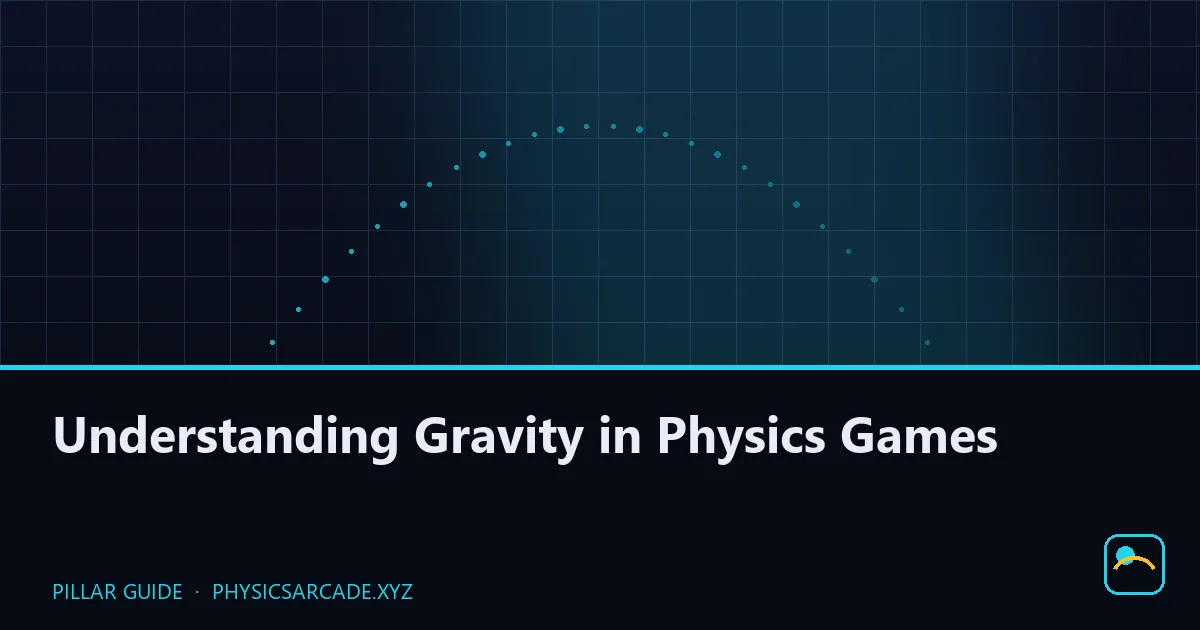
Gravity here is a vector, not a number. Flipping reverses its direction while leaving its magnitude alone, so you fall upward exactly as fast as you fall downward. Every body in the level responds at the same instant.
Momentum through the flip
Flipping does not touch your horizontal velocity. Speed built running along the floor carries straight into the ceiling run, which is the only reliable way to clear the long gaps in the later sectors.
Ground detection
Whether you are 'on the ground' is decided by comparing the contact normal against the current gravity direction. That single check is why standing on the ceiling behaves identically to standing on the floor.
Eased transitions
The field does not snap between directions — it interpolates over roughly a tenth of a second. During that window the force acting on you is genuinely smaller than full gravity in either direction, which is why a mid-air flip briefly feels weightless. Snapping instantly reads as a rendering glitch rather than a physical event, so the easing is a deliberate design choice made for legibility rather than for accuracy.
Objective
Reach the green gate at the end of each sector. Clear all six to finish the run.
Scoring
- Each energy cell is worth 120 points.
- Clearing a sector awards 500 points plus a time bonus that decays at 45 points per second.
- Every collected cell adds a further 60 points to the sector bonus.
Scores, favourites and play history are stored in your own browser using localStorage. There is no account, no leaderboard and no server: clearing your browser data clears them, and they do not follow you to another device.
Tips
- Flip before the obstacle, not at it. The field takes a moment to reverse and you still have to cross the corridor. Start the flip roughly one capsule-width early.
- Keep running through the flip. Releasing the direction key mid-flip kills the momentum you need on the other side.
- Cells mark the safe lane. Energy cells are always placed on the side the obstacle is not. If you can see a cell, that is the lane you want.
- Do not double-flip. There is a short cooldown after each flip. Tapping twice in quick succession leaves you halfway between surfaces with no control.
- Read the arrow on the capsule. The small dark arrow inside the capsule always points the way gravity is currently pulling.
Difficulty
Medium. Sector one is a tutorial in practice — obstacles are far apart and there are no spikes. By sector four the spacing is tight enough that you have to plan two obstacles ahead, and spike density rises with every sector.
Features
- Six procedurally built sectors that get longer and denser
- Gravity that eases between directions instead of snapping
- Energy cells positioned to reward committing to a flip
- Spike hazards on alternating sides of the corridor
- Per-sector time bonus and a total-run clock
How accurate is this?
Physics Arcade games use simplified, tuned physics built for playability. They are not scientific simulations: forces, masses and timings are chosen because they feel good at 60 frames per second, not because they match measured values. Where a game departs from real-world behaviour in a way that matters, the game page says so.
Gravity Switch – FAQ
Can I flip gravity in mid-air?
Yes, and you often have to. Flipping mid-air is how you cross gaps that are too wide to run across on either surface.
Why did my flip not register?
There is a short cooldown after each flip to stop rapid double-taps leaving you stranded mid-corridor. Wait about a fifth of a second between flips.
Do the energy cells do anything besides score?
They are score only, but they are deliberately placed to show you the safe route through each obstacle pair.
What happens if I touch a spike?
The run ends immediately. Spikes are the only instant-fail hazard; solid blocks just stop you.