About this game
Physics Arcade Ultimate is the flagship: a single run through six zones, each built on a different part of the engine. The Gravity Zone gives you flip pads. The Bounce Zone gives you elastic pads and gaps. The Balance Zone gives you see-saw platforms that rotate under your weight. Motion changes the grip under your feet every few metres. Collision sends heavy rolling masses at you. Force fills the corridor with attract and repel fields.
Nothing about the character changes between zones. The same body, the same controls, the same solver — only the environment changes, which is the point. Three laps through all six, with rising difficulty and three lives to spend.
How to play
- Run right with the arrow keys and jump with Space.
- On a purple flip pad, Space flips gravity instead of jumping.
- Collect green energy cells and grab power-ups: Shield absorbs one hit, Boost adds speed, Float halves gravity.
- Reach the green gate at the end of each zone.
- You have three lives. Losing one restarts the current zone, not the run.
Physics mechanics
Here is what the simulation is actually doing while you play.
Gravity Zone — directional gravity
Flip pads reverse the gravity vector. Your horizontal momentum survives the flip, which is how you carry speed from the floor run onto the ceiling.
Bounce Zone — restitution
The gold pads have a restitution near 0.94, returning almost all the speed you bring. Landing on one at pace is what clears the wide gaps.
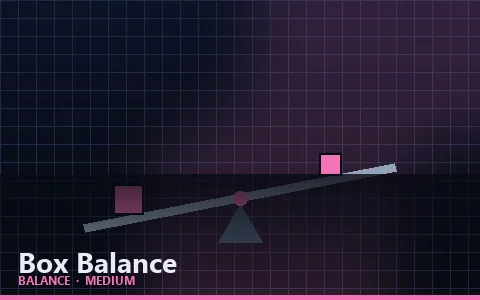
Balance Zone — torque
See-saw platforms rotate based on where your weight sits relative to their pivot. Standing still on one end tips it; running across keeps it level.
Motion Zone — friction coefficients
Each surface section has a different friction coefficient drawn from the same material table the rest of the site uses. Conveyors add a target velocity you get dragged towards.
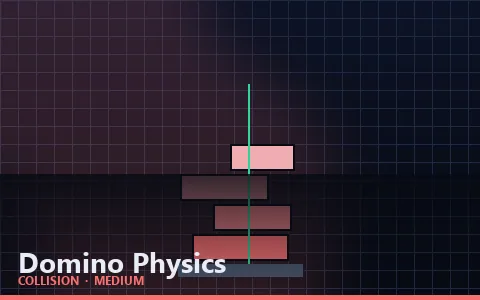
Collision Zone — momentum
The rolling masses are heavy bodies with real momentum. A head-on contact above the closing-speed threshold costs you a life; a glancing one does not.
Force Zone — field forces
Attract and repel regions apply linear-falloff forces. They pull you off your line continuously, so the route through a gate is a curve, not a straight run.
Objective
Reach the gate at the end of all six zones, three times, without running out of lives.
Scoring
- Each energy cell is worth 100 points; each power-up 200.
- Completing a zone awards 600 points, plus a time bonus and 50 per cell collected in that zone.
- Completing a full lap of all six zones awards a further 1,500 points.
Scores, favourites and play history are stored in your own browser using localStorage. There is no account, no leaderboard and no server: clearing your browser data clears them, and they do not follow you to another device.
Tips
- Learn the zones separately. Each zone teaches one system. If one keeps ending your run, the guide for that mechanic is more useful than another attempt.
- Shield is for the Collision Zone. Save a shield if you can reach the Collision Zone with it. It absorbs exactly one roller hit, which is the most common way runs end.
- Keep moving on see-saws. A see-saw only tips if you stand on it. Running across at speed barely rotates it at all.
- Conveyors can be ridden. A forward-running conveyor in the Motion Zone is free speed. Note which way the arrows point before you step on.
- Boost is a liability in Force. Extra speed makes the field curves harder to correct. If you are carrying Boost into the Force Zone, it is often better to let it expire.
Difficulty
Expert. Not because any individual zone is brutal, but because a run asks you to switch mental models six times without dying. Most players clear two or three zones comfortably on a first attempt and lose a life the moment the rules change. Lap three is genuinely demanding.
Features
- Six distinct zones, each built on a different engine system
- Three power-ups: Shield, Boost and Float
- Energy cells and per-zone completion bonuses
- Three lives, with a zone restart rather than a full reset
- Three laps of increasing difficulty
How accurate is this?
Physics Arcade games use simplified, tuned physics built for playability. They are not scientific simulations: forces, masses and timings are chosen because they feel good at 60 frames per second, not because they match measured values. Where a game departs from real-world behaviour in a way that matters, the game page says so.
Physics Arcade Ultimate – FAQ
Do I lose the whole run when I lose a life?
No. Losing a life restarts the current zone with your score intact. Only running out of lives ends the run.
What does each power-up do?
Shield absorbs one hit and then disappears. Boost increases your acceleration for six seconds. Float halves the gravity acting on you for six seconds.
Why does Space sometimes flip instead of jumping?
You are standing on a purple flip pad. On a pad, Space flips gravity; everywhere else it jumps.
Are the zones always in the same order?
Yes: Gravity, Bounce, Balance, Motion, Collision, Force. The layouts within each zone change between laps.