A physics arcade game is one where the rules of motion do the work. Instead of a character that moves exactly as far as you press, you get an object with mass that accelerates, carries momentum, bounces off things and eventually stops — and the game is about learning to work with that rather than around it.
That single design decision changes everything downstream. It makes the controls indirect, the failures legible and the mastery transferable: once you understand why a rolling sphere climbs a hill better than a sliding block, you understand it in every game that models both. This guide covers what the genre is, how its six main families differ, what is really happening under the canvas, and how to get better at all of it.
What makes a game a physics game
Almost every game has some physics. What separates a physics arcade game is that the simulation is the source of difficulty rather than a decoration on top of it.
In a conventional platformer, a jump is usually an animation curve. The character rises a fixed height over a fixed time, and the designer tunes those numbers until they feel right. In a physics platformer, the jump is an impulse applied to a body with mass, and everything that follows — the arc, the landing, the slide, the way a slope changes the outcome — falls out of the simulation.
The practical test is whether the game can surprise its own designer. If dropping a crate at an unusual angle produces a result nobody scripted, the physics is real.
The three things a physics engine actually does
It integrates motion (turning forces into velocity and velocity into position), it detects collisions (working out which objects are touching and where), and it resolves them (deciding what happens next). Everything else — springs, ropes, buoyancy, gravity wells — is built on top of those three.
Direct control versus indirect control
The clearest marker of the genre is indirect control. In Magnet Motion you never touch the orb at all — you move a magnet and the orb answers. In Gravity Painter you draw surfaces and press release. In Force Field you place emitters and then have no input whatsoever.
Indirect control is what makes these games feel like experiments. You set up conditions, you commit, and you watch the consequences. When it goes wrong, the reason is visible on screen rather than hidden in a failure table.
Try it: Newton's Playground
A sandbox with a job to do: spawn, flick, change gravity, fill the collector.
Play Newton's PlaygroundThe six families of physics arcade game
Physics games cluster naturally around which property of motion they make you manage. These six cover almost everything in the genre, and they are the categories this site is organised around.
1. Gravity games
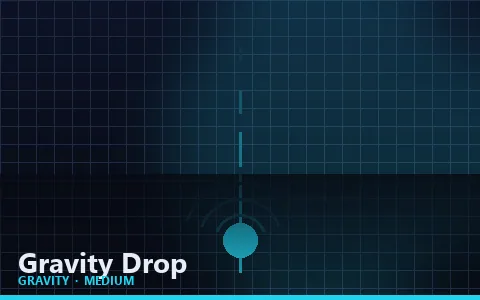
Gravity games make the field itself the variable. Sometimes it points a different way, sometimes it is weaker or stronger, sometimes it comes from a point rather than from below. The skill is planning around a force you cannot switch off.
Examples on this site: Gravity Drop, Gravity Switch, Orbital Dash.
2. Balance and stability games
These are decided by one question: is the centre of mass over the base? Stacking games, see-saw games and construction games all reduce to that, and they are the most legible physics games because the failure is visible several seconds before it happens.
Examples: Box Balance, Stack Physics, Bridge Builder Physics.
3. Projectile games
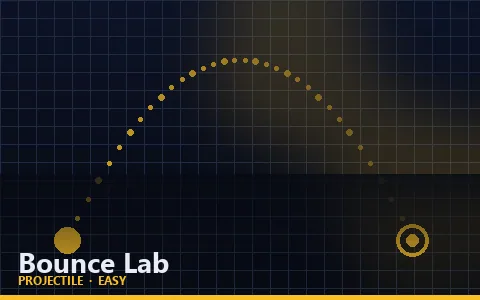
You set an angle and a speed, the object leaves your control, and gravity decides the rest. Projectile games are the oldest family in the genre and the easiest to reason about, because the arc has a closed-form solution you can genuinely learn to eyeball.
Examples: Cannon Curve, Ricochet Lab, Bounce Lab.
4. Collision games
Here the interesting moment is the impact itself: what transfers, what bounces, what topples. Chain reactions, domino runs and many-body swarms all live here.
Examples: Chain Reaction Lab, Domino Physics, Particle Push.
5. Momentum and motion games
Momentum games are about the speed you already have. Friction, rolling, swinging and drifting all belong here, and the characteristic skill is spending momentum well rather than generating more of it.
Examples: Rolling Reactor, Friction Runner, Rope Swing.
6. Physics puzzle games
Physics puzzles remove the real-time element almost entirely. You arrange the conditions, press go, and the simulation resolves. They are the most accessible entry point because reaction speed never matters.
Examples: Gravity Painter, Force Field, Gravity Maze.
| Family | You manage | Fails when | Typical skill |
|---|---|---|---|
| Gravity | Direction and strength of the field | You are in the wrong place when it acts | Planning ahead |
| Balance | Where the centre of mass sits | It leaves the base | Spatial judgement |
| Projectile | Angle and launch speed | The arc misses | Estimation |
| Collision | What hits what, and how hard | Energy runs out | Setup reading |
| Momentum | Speed you already have | You waste it | Route choice |
| Puzzle | The initial conditions | The setup was wrong | Deduction |
What is happening under the canvas
You do not need to know any of this to play. But knowing it makes the games considerably easier, because the behaviour stops being arbitrary.
The loop
A physics game runs a loop many times a second. Each pass does roughly the same four things: gather the forces acting on every object, use them to update velocities and positions, find out which objects now overlap, and push them apart in a way that looks like a collision.
Fixed timesteps
Frame rates vary — a phone may run at 30 frames a second, a gaming monitor at 144. If the simulation simply used the frame time, the game would behave differently on different hardware, and physics would be subtly wrong.
The standard answer is a fixed timestep: the simulation always advances in identical slices (this site uses 120 per second), and a small accumulator decides how many slices to run each frame. That is why a jump in any game here reaches the same height on every device.
Why the order of operations matters
Updating velocity before position — semi-implicit Euler — keeps orbits and springs stable. Doing it the other way round slowly adds energy to the system, and after a minute a pendulum will be swinging higher than it started. It is a one-line difference with enormous consequences.
Collision in two phases
Testing every object against every other object is fine for twenty objects and disastrous for two hundred. Engines therefore split the job: a cheap broad phase throws away pairs that cannot possibly touch, and an expensive narrow phase works out the exact contact for the few pairs that survive.
That is the difference between Particle Push running smoothly on a phone and not running at all.
How to get better at physics games
Physics games reward a specific kind of attention, and it is not the one most action games train.
- Watch one failure properly. Most players restart instantly. Watching the whole failure tells you which force actually beat you.
- Identify the dominant force. In any given moment one force is doing most of the work. On ice it is momentum; on a see-saw it is torque; near a planet it is gravity. Work with that one.
- Commit earlier. Almost every physics game punishes late corrections, because forces take time to act. The single most common improvement is starting each manoeuvre sooner.
- Stop fighting the simulation. If you are holding a key to counteract something continuously, you are usually in the wrong place. Move somewhere the forces already point where you want to go.
- Learn one game deeply. The mental model transfers. Understanding restitution through Bounce Lab makes Ricochet Lab, Spring Jump and the Bounce Zone of the flagship immediately more readable.
- Treating a physics game like a precision platformer. Precision platformers respond instantly. A body with mass does not. Inputs are requests, not commands.
- Using maximum power by default. Full power is right surprisingly rarely. In Bounce Lab a slower orb bounces more and scores more; in Magnet Motion a full pull is uncontrollable.
- Correcting instead of planning. Continuous small corrections usually make things worse in a system with momentum, because each correction has to be undone.
- Ignoring the readouts. Every game on this site displays the quantity that actually decides it — tilt, speed, centre of mass, period. They are there because they are the answer.
Try it: Physics Arcade Ultimate
Six zones, one run: gravity, bounce, balance, motion, collision and force.
Play Physics Arcade UltimatePlaying physics games in a browser
Every game on this site runs in a browser tab with no plugin, no download and no account. That is possible because of three web technologies that matured at roughly the same time.
- HTML5 Canvas gives a page a drawing surface that can be repainted sixty times a second.
- requestAnimationFrame synchronises that repainting with the display refresh, so the animation is smooth and stops entirely when the tab is hidden.
- Pointer events unify mouse, touch and pen into one code path, which is why the same game works with a mouse and with a thumb.
The trade-off is a performance budget. A browser game shares the machine with the browser itself, so a physics engine for the web has to be frugal in ways a desktop engine does not — capping particle counts, pooling objects, and using a spatial hash rather than testing every pair.
No downloads, ever
If a site offering free browser games asks you to install something to play them, that is a red flag rather than a requirement. Canvas games need nothing beyond the browser you already have.
Are physics games actually educational?
Partly, and it is worth being precise about which part.
What a physics game teaches well is intuition: the shape of a relationship, the direction of an effect, what happens when you change one variable. After an hour of Spring Jump you have a genuine feel for the fact that stored spring energy grows with the square of compression, because you have spent an hour being rewarded for it.
What a physics game teaches badly is numbers. Arcade physics is tuned for playability: gravity is set to whatever makes a fall feel right at sixty frames a second, not to 9.81 metres per second squared. Friction coefficients are ordered correctly — ice really is slipperier than rubber — but the values are chosen for feel.
Where arcade physics departs from the real thing
Restitution is treated as a fixed property of a material, when in reality it varies with impact speed. Air resistance is usually either linear or ignored. Rotational inertia is often simplified. None of these break the intuition, but none of them would survive a physics exam.
The honest summary is that physics games are excellent at building the intuition a textbook assumes you already have, and useless as a substitute for the textbook. Used in that order they work well together — which is why every game page on this site explains what its game is modelling and where it stops.
Key takeaways
- A physics arcade game is one where the simulation is the source of difficulty, not decoration.
- The genre splits into six families: gravity, balance, projectile, collision, momentum and puzzle.
- Indirect control is the defining feature — you set up conditions and the physics resolves them.
- Fixed timesteps are why a physics game behaves identically on a phone and a desktop.
- The fastest way to improve is to commit earlier and to watch one failure properly.
- These games build genuine physical intuition, but their numbers are tuned for play rather than accuracy.
Frequently asked questions
What is a physics arcade game?
A game where motion is produced by a simulation — objects have mass, accelerate under forces, carry momentum and collide — rather than by scripted animation. The physics is the source of the challenge rather than a visual effect on top of it.
Are physics arcade games free to play online?
Every game on Physics Arcade is free, runs in the browser and needs no download, account or plugin. The site is supported by advertising rather than by charging for games.
Do I need to know physics to play them?
No. The games are designed to be readable without any background — the intuition comes from playing. Understanding the underlying idea makes them easier, which is why each game page explains what it is simulating.
Which physics game should I start with?
Newton's Playground if you want to experiment freely, Bounce Lab if you want something immediately satisfying, and Gravity Maze if you prefer puzzles with no time pressure.
Can I play physics games on a phone?
Yes. Every game here supports touch input, and games that need directional control show on-screen buttons below the play area rather than overlaying the canvas.
Are these real physics simulations?
They use real physical relationships — forces, momentum, torque, restitution — but the values are tuned for playability rather than accuracy. They are simplified arcade models, and each game page says where it simplifies.
References
Physical concepts in this guide were checked against the following educational sources. None of them are affiliated with Physics Arcade.