Restitution is one number that decides whether a surface feels like concrete, like a trampoline or like wet sand. It is the fraction of approach speed an object gets back after a collision, and it ranges from zero — a complete stop — to one, a bounce that loses nothing at all.
It is also the number games lie about most freely, for good reasons. This guide covers what restitution really is, why real bounces lose energy, how games stop objects buzzing forever, and how bounce is used as a gameplay tool.
What restitution measures
The coefficient of restitution is the ratio of separation speed to approach speed in a collision. Drop a ball at 10 metres per second and if it leaves the floor at 8, the restitution of that pair is 0.8.
It is a property of the pair of materials, not of one object alone. A rubber ball on concrete and the same ball on carpet have quite different values. Games usually simplify this by giving each object a restitution and combining the two — most commonly by taking the minimum, which means one dead surface kills the bounce regardless of what hits it.
| Restitution | Behaviour | Example on this site |
|---|---|---|
| 0.0 – 0.1 | Dead stop, no bounce | Damper slabs in Bounce Lab |
| 0.2 – 0.4 | Subtle bounce, quickly settles | Most crates and planks |
| 0.5 – 0.7 | Clearly springy | Arena walls in Zero Gravity Arena |
| 0.8 – 0.95 | Very lively, keeps going | Bounce pads, chamber walls |
| 1.0 | Loses nothing — not physically real | Ricochet Lab walls |
Restitution and energy
Because kinetic energy goes with the square of speed, a restitution of 0.8 returns 80% of the speed but only 64% of the energy. That is why a bouncing ball's height drops so much faster than its speed does — height is proportional to energy, not to speed.
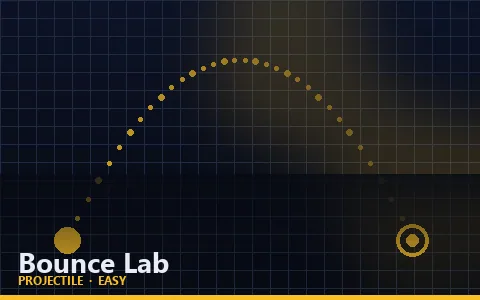
Try it: Bounce Lab
Fire an elastic orb into a chamber and clear the targets with the bounces you have left.
Play Bounce LabWhere the missing energy goes
A restitution below 1 means energy left the system. It is not destroyed — it becomes other things.
- Heat. The dominant destination. Materials deform on impact and internal friction converts motion into thermal energy.
- Sound. A small fraction, but it is genuinely the bounce noise you hear — the energy carried away as a pressure wave.
- Permanent deformation. If something dents, that reshaping consumed energy that never comes back.
- Vibration. The object may still be ringing after it leaves the surface.
This is why perfect restitution is impossible in reality. A collision with no loss at all would require perfectly rigid, perfectly elastic materials with no internal friction, which do not exist.
Elastic and inelastic
A perfectly elastic collision conserves kinetic energy (restitution 1). A perfectly inelastic collision has restitution 0 — the objects move together afterwards, and the maximum possible energy is lost. Everything real sits in between.
Momentum, by contrast, is conserved in every collision regardless of restitution. That distinction is the single most useful thing to know about collisions.
Why games use restitution values that do not exist
Several games on this site use a restitution of exactly 1.0, which is physically impossible. That is deliberate.
Ricochet Lab requires you to bank a shot off walls a specific number of times before it reaches the target. If each bounce lost energy, the required route would become impossible after a few bounces, and the difficulty would come from the engine running out rather than from your reasoning.
Making the walls perfectly elastic turns the puzzle into pure geometry. Every path is straight lines, every bounce is exactly predictable, and the challenge is entirely about seeing the route.
Bumpers add energy
The purple bumpers in Bounce Lab go further — they return more than they receive, by applying an extra impulse along the contact normal. That is a restitution greater than 1, which is impossible for a passive object.
But it is not unphysical in a broader sense: a real pinball bumper is powered, and the extra energy comes from a solenoid. The game is modelling an active device rather than breaking conservation of energy.
Where the cheat shows
Perfect restitution means an object never settles. Games that use it need another way to end a shot — a flight timer, a boundary, or a minimum speed check. Ricochet Lab uses a 12-second limit for exactly this reason.
The buzzing problem and how to fix it
Drop a ball with restitution 0.7 and watch it in a naive simulation. It bounces high, then lower, then lower still — and then it never stops. The bounces become microscopic and the ball buzzes against the floor indefinitely.
Mathematically this is correct: 70% of any number is still a number. Physically it is wrong — a real ball settles because at small amplitudes the energy is entirely absorbed by deformation.
The rest threshold
The standard fix is to treat contacts below a certain closing speed as resting rather than bouncing. Below the threshold, restitution is forced to zero and the object simply stops.
The engine behind these games uses a threshold of about 34 pixels per second. Any contact slower than that is treated as a rest contact, which is why stacks in Stack Physics hold perfectly still rather than trembling.
The slop tolerance
A second fix addresses positions rather than velocities. Overlapping objects are pushed apart, but only by the amount that exceeds a small tolerance. Without it, the corrector and gravity fight each other every frame and produce visible vibration.
Why both are needed
The rest threshold stops velocity oscillation; the slop stops positional oscillation. They address different symptoms of the same underlying problem — that a discrete simulation cannot represent a continuous resting contact exactly.
Bounce as a gameplay tool
Restitution is unusually versatile as a design lever, because it can make a surface helpful, hostile or neutral without changing its geometry.
High restitution as a reward
Bounce pads in Spring Jump return more than they receive, so reaching one is free height. They are placed to reward good routing rather than raw charge.
High restitution as a hazard
The same property is a threat in Gravity Drop, where the pink rubber bars fling you back upward — usually straight into the rising hazard line. Identical physics, opposite meaning, decided entirely by context.
Low restitution as a wall
The damper slabs in Bounce Lab have a restitution near 0.08. They do not kill you; they simply end your shot, which makes them obstacles you route around voluntarily.
Bounce as a scoring multiplier
Bounce Lab pays more for targets hit after more bounces, which aligns the scoring with the physics. The interesting shot and the high-scoring shot are the same shot.

Try it: Ricochet Lab
A direct hit scores nothing. Bank the shot the required number of times first.
Play Ricochet LabPlaying bounce games well
- Slower is often better. A slower projectile spends longer bouncing and covers more of the chamber. Maximum power is rarely the high-scoring option.
- Aim at surfaces, not targets. In a bounce game the first contact matters more than the last. Choose the wall that sets up the rest of the path.
- Corners give two bounces cheaply. A shot into a corner bounces twice in quick succession, which pads a bounce count for almost no distance.
- Identify the dead surfaces first. Low-restitution objects end shots. Knowing where they are is worth more than knowing where the targets are.
- Use the preview properly. Numerical previews trace real bounces. Count the corners in the dotted line before you commit.
- Firing at full power by default. A fast object bounces fewer times before the shot ends, and in games that score bounces, that is a direct loss.
- Treating a bounce as random. It is exactly determined by the contact normal. If a bounce surprised you, the surface angle was different from what you assumed.
- Forgetting that restitution combines. A lively ball hitting a dead surface gives a dead bounce. The surface usually wins.
Working out bounce height
One short calculation makes restitution genuinely intuitive, and it explains why bouncing objects settle so much faster than people expect.
Drop an object from height h. It arrives at the ground with some speed, and leaves with restitution times that speed. Since the height it reaches depends on the square of its launch speed, the rebound height is the restitution squared times the original height.
| Restitution | Bounce 1 | Bounce 2 | Bounce 3 | Bounce 5 |
|---|---|---|---|---|
| 0.9 | 81% | 66% | 53% | 35% |
| 0.8 | 64% | 41% | 26% | 11% |
| 0.7 | 49% | 24% | 12% | 3% |
| 0.5 | 25% | 6% | 2% | 0.1% |
A ball with a restitution of 0.7 — which feels quite bouncy in the hand — is down to a tenth of its drop height after three bounces. That is why real bouncing looks like it decays so quickly: the squared relationship compounds fast.
Total distance is finite
Here is the result that surprises people. Although a perfectly modelled bouncing ball makes infinitely many bounces, the total distance it travels is finite — the series converges. So is the total time. Mathematically the ball comes to rest after a finite period despite bouncing infinitely often in it.
Physically this never happens, because deformation absorbs the last tiny bounces entirely. In a simulation it also never happens, because the rest threshold cuts them off. But it is a genuinely interesting piece of mathematics hiding inside a familiar everyday object.
Why this matters for a game
If you are designing a bounce game, the number of useful bounces is roughly how many it takes to fall below the rest threshold. At restitution 0.86, as in Bounce Lab, that is around eight to ten — which is exactly why the scoring caps the bounce bonus at eight.
Key takeaways
- Restitution is the fraction of approach speed returned after a collision.
- It returns speed, not energy — 0.8 restitution returns 80% of speed but only 64% of energy.
- Missing energy becomes heat, sound, deformation and vibration; perfect bounce is impossible in reality.
- Momentum is conserved in every collision; kinetic energy only in perfectly elastic ones.
- Games use rest thresholds and slop tolerances to stop bouncing objects buzzing forever.
- The same high restitution is a reward in one game and a hazard in another — context decides.
Frequently asked questions
What is the coefficient of restitution?
The ratio of separation speed to approach speed in a collision. Zero means a dead stop, one means no energy is lost. It is a property of the pair of materials rather than of a single object.
Why do bouncing balls eventually stop?
Every real bounce loses energy to heat, sound and deformation. Since height is proportional to energy and energy goes with the square of speed, the height drops much faster than the speed does.
Can restitution be greater than 1?
Not for a passive collision — that would create energy. Games use values above 1 to model powered devices like pinball bumpers, where the extra energy genuinely comes from a solenoid.
Why do objects vibrate when resting in some games?
Because a discrete simulation cannot represent a continuous resting contact exactly. Engines fix it with a rest threshold, which forces restitution to zero below a small closing speed, and a slop tolerance on positional correction.
How does restitution combine between two objects?
Most engines take the minimum of the two values, so a single dead surface kills the bounce regardless of what hits it. Some use the average or the product; the minimum is the most predictable for gameplay.
Is a bounce in a game random?
No. It is exactly determined by the contact normal and the restitution. If a bounce surprises you, the surface angle was different from what you assumed.
References
Physical concepts in this guide were checked against the following educational sources. None of them are affiliated with Physics Arcade.