A logic puzzle has one correct answer that you verify by reasoning. A physics puzzle has a space of answers that you verify by running a simulation. That difference changes almost everything about how the genre feels and how you should approach it.
It also produces a distinctive rhythm: set up, commit, observe, adjust. You are never mid-solution the way you are in a platformer, because the solution is already fixed by the time anything starts moving. This guide covers what makes physics puzzles work, what makes a bad one, and how to solve them faster.
Setup, commit, observe
Almost every physics puzzle follows the same three-beat structure, and recognising it makes the genre far less frustrating.
- Setup. You arrange conditions — placing objects, drawing surfaces, choosing an angle. There is usually no time pressure at all during this phase.
- Commit. You press go. From this moment you have no further input, or almost none.
- Observe. The simulation resolves. Whether you were right is now a matter of watching rather than doing.
Force Field is the purest example: you place emitters, press launch, and then genuinely cannot affect anything. Gravity Painter is the same with drawing. Chain Reaction Lab gives you exactly one decision — where the trigger falls — before the entire cascade plays out.
Why committing is the point
If you could correct mid-flight, the puzzle would become a steering challenge and the setup would stop mattering. Removing input after the commit is what forces you to actually predict the physics rather than react to it.

Try it: Force Field
Place emitters, press launch, and let the fields you left behind do the work.
Play Force FieldWhy they feel different from logic puzzles
Four differences account for most of the distinctive feel.
The answer space is continuous
A sliding-block puzzle has a finite number of moves. A physics puzzle usually has infinitely many possible placements, most of which nearly work. That is why 'almost' is such a common outcome and why small adjustments are so often the right response.
Failure is informative
A wrong answer in a logic puzzle tells you very little. A failed physics attempt shows you the entire trajectory of the failure — where the orb went, where the chain stopped, which way the tower leaned. The failure is a measurement.
Solutions are not unique
Most physics puzzles have many working solutions, some elegant and some brutish. Good ones score elegance: Force Field pays 150 points for every unused emitter, so the minimal solution is also the high-scoring one.
Intuition transfers
Solving one physics puzzle genuinely helps with the next, because you are learning how the world behaves rather than a specific trick. Logic puzzle insights are usually far more local.
What makes a good physics puzzle
The genre has a well-defined set of failure modes, and avoiding them is most of the design work.
The simulation must be legible
Players need to be able to predict what will happen. That means showing the relevant quantity: the ink meter, the field radius, the centre-of-mass line, the reach arc. A hidden variable turns deduction into guesswork.
It must be deterministic
The same setup must produce the same result every time. If it does not, players cannot learn from a failure, and the puzzle stops being a puzzle. Every level in these games is generated from a fixed seed for exactly this reason.
Retrying must be cheap
Since the loop is setup-commit-observe, a long reset punishes exactly the experimentation the design depends on. Undo that refunds your resources — as in Gravity Painter — is better still.
It should reward elegance
Without a reason to find a better solution, players stop at the first one that works. Scoring unused resources is the simplest effective mechanism.
- Hidden variables. If the outcome depends on something the player cannot see, the puzzle is unfair regardless of how good the physics is.
- Pixel-perfect solutions. If only one placement in a hundred works, the challenge has become execution rather than understanding.
- Non-deterministic simulation. Frame-rate-dependent physics is the classic culprit, and it makes every failure uninformative.
- Expensive retries. A ten-second reset animation is a tax on the exact behaviour the genre requires.
How to solve physics puzzles faster
These techniques generalise across essentially every physics puzzle, and they are the difference between grinding and solving.
1. Run it empty first
Before placing anything, commit with nothing. Watching the object's natural path tells you exactly where it needs correcting, which is worth far more than a hopeful first attempt.
2. Work backwards from the goal
Ask what the object must be doing just before it succeeds — which direction, how fast. Then ask what would produce that. Chaining backwards converges much faster than trying things forwards.
3. Change one thing at a time
If you adjust two placements between attempts and the result changes, you have learned nothing about either. This is the single most common time-waster in the genre.
4. Place early rather than late
In most physics puzzles, an influence applied early has far more effect than the same influence applied late, because the object is slower and there is more time for the effect to accumulate.
5. Use the resource cost as a hint
If a puzzle gives you exactly two emitters, the intended solution uses two. A tight budget is a designer telling you the shape of the answer.

Try it: Gravity Painter
You cannot touch the orb. You can only draw the world it falls through.
Play Gravity PainterPuzzles versus sandboxes
There is a real tension in physics puzzle design between freedom and direction, and different games resolve it differently.
A pure sandbox gives you tools and no goal. It is excellent for building intuition and poor at sustaining attention, because without a goal there is no reason to engage with a difficult problem.
A pure puzzle gives you a goal and exactly the tools to reach it. It sustains attention well and teaches less, because you are following a designed path rather than exploring.
Newton's Playground sits deliberately between the two: a sandbox with a quota and a clock. You can spawn whatever you like and flick it however you like, but you have to get a certain number of objects into a collector before time runs out. The freedom is real; the direction is also real.
Why constrained sandboxes work
A goal gives players a reason to discover the tools, and freedom gives them more than one way to reach the goal. Almost every long-lived physics puzzle game sits somewhere on this spectrum rather than at either extreme.
How difficulty is built
Physics puzzles get harder along a small number of axes, and recognising which one a game is using tells you what to practise.
| Axis | How it escalates | Example |
|---|---|---|
| Resource budget | Fewer tools for the same job | Force Field: 6 emitters down to 2 |
| Obstacle density | More things in the way | Gravity Painter: more blocks per sketch |
| Precision required | Narrower windows | Magnet Motion: gates get tighter |
| Chain length | More steps must all work | Chain Reaction Lab: more stages |
| Added dimension | A new variable enters | Gravity Maze: spikes from maze three |
The best escalation is resource reduction, because it makes the player re-examine a solved problem rather than solve a bigger one. The worst is precision, because past a point it stops being about understanding at all.
How to read a puzzle layout
Before touching anything, a physics puzzle can usually be read. These are the questions worth asking in order, and they resolve most puzzles faster than experimentation does.
- Where does the object start, and which way is it already going? Most puzzles give the object an initial velocity or an initial position under gravity. That determines the natural path.
- What is the obstacle actually blocking? Usually a barrier is not there to be avoided but to force a specific detour. Ask what route it is ruling out.
- How many resources do I have? A budget of exactly two emitters means the intended solution uses two. The budget is a hint about the shape of the answer.
- Where must the object be just before it succeeds? Working backwards from the goal usually converges faster than working forwards from the start.
- What has the designer made visible? A drawn radius, a printed coefficient, a reach arc. Anything shown on screen is shown because you need it.
The one-influence principle
Most physics puzzles are solvable with fewer influences than they give you, applied at the right moment. A single well-placed attractor near the launcher does more than three scattered ones, because the object is slowest there and spends the longest inside the field.
That principle generalises: in any setup puzzle, the earliest influence is the most powerful, and the temptation to add more later usually reflects a placement that was wrong at the start.
Recognising an over-constrained attempt
If your solution needs four things to all work perfectly, it is probably not the intended one. Physics puzzles are usually designed around a solution with margin. A fragile answer that occasionally works is a signal to step back rather than to retry.
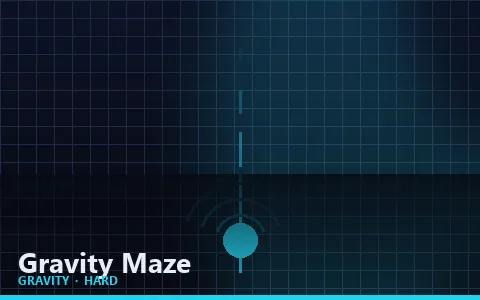
Try it: Gravity Maze
Choose which way is down and the cube slides until something stops it.
Play Gravity MazeKey takeaways
- Physics puzzles run on a setup-commit-observe loop, with no input after the commit.
- The answer space is continuous, so 'almost' is common and small adjustments are the right response.
- A failed attempt is a measurement — watch the whole failure before restarting.
- Good physics puzzles are legible, deterministic, cheap to retry and reward elegance.
- Running the puzzle empty first is the fastest way to learn what needs correcting.
- Influences applied early matter far more than the same influence applied late.
Frequently asked questions
What makes a physics puzzle different from a logic puzzle?
A logic puzzle is verified by reasoning and usually has one answer. A physics puzzle is verified by running a simulation and usually has many valid answers, some more elegant than others.
Why can I not control anything after launching?
Because mid-flight control would turn the puzzle into a steering challenge and make the setup irrelevant. Removing input after the commit is what forces you to predict rather than react.
What is the fastest way to solve a physics puzzle?
Run it once with nothing placed to see the natural path, then work backwards from the goal, then change one thing at a time between attempts. Most wasted time comes from changing two things at once.
Why do physics puzzles use fixed random seeds?
So the same level is identical every time. Without determinism, a failed attempt teaches you nothing, and the puzzle stops being solvable by reasoning.
Are physics puzzles good for learning physics?
They build strong intuition about how relationships behave — what happens when you change one variable — but they are poor at teaching numbers, because arcade physics values are tuned for play rather than accuracy.
Why do some physics puzzles reward using fewer tools?
Because without that incentive, players stop at the first solution that works. Scoring unused resources makes the elegant solution and the high-scoring solution the same thing.
Is there always only one solution?
Almost never. Physics puzzles usually have a continuous space of working setups, some far more efficient than others. That is a feature: it means two players can solve the same level in genuinely different ways and both be right.
Why does my solution work sometimes but not always?
If the game is deterministic — and every puzzle here is, using fixed level seeds — an identical setup gives an identical result. A solution that works intermittently means your setup is not actually identical between attempts, usually because a placement is a few pixels different.
Should I use all the resources a level gives me?
Not necessarily. A tight budget is a hint about the shape of the intended solution, but finishing with resources unspent usually scores higher. Use the budget as information about difficulty, not as a target to hit.
References
Physical concepts in this guide were checked against the following educational sources. None of them are affiliated with Physics Arcade.